
01
A pre-wedding shoot built around the character of the Paris Opera.
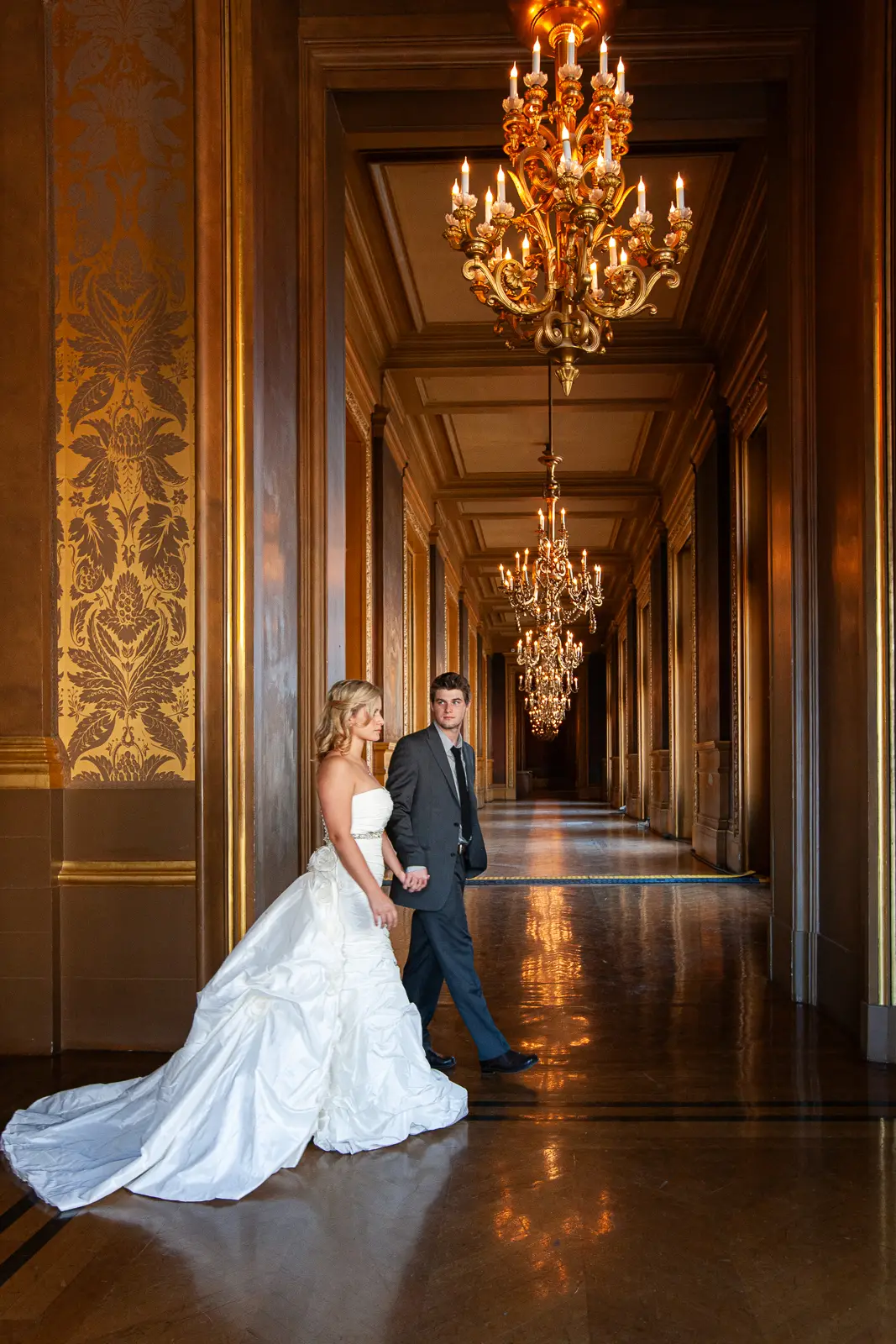
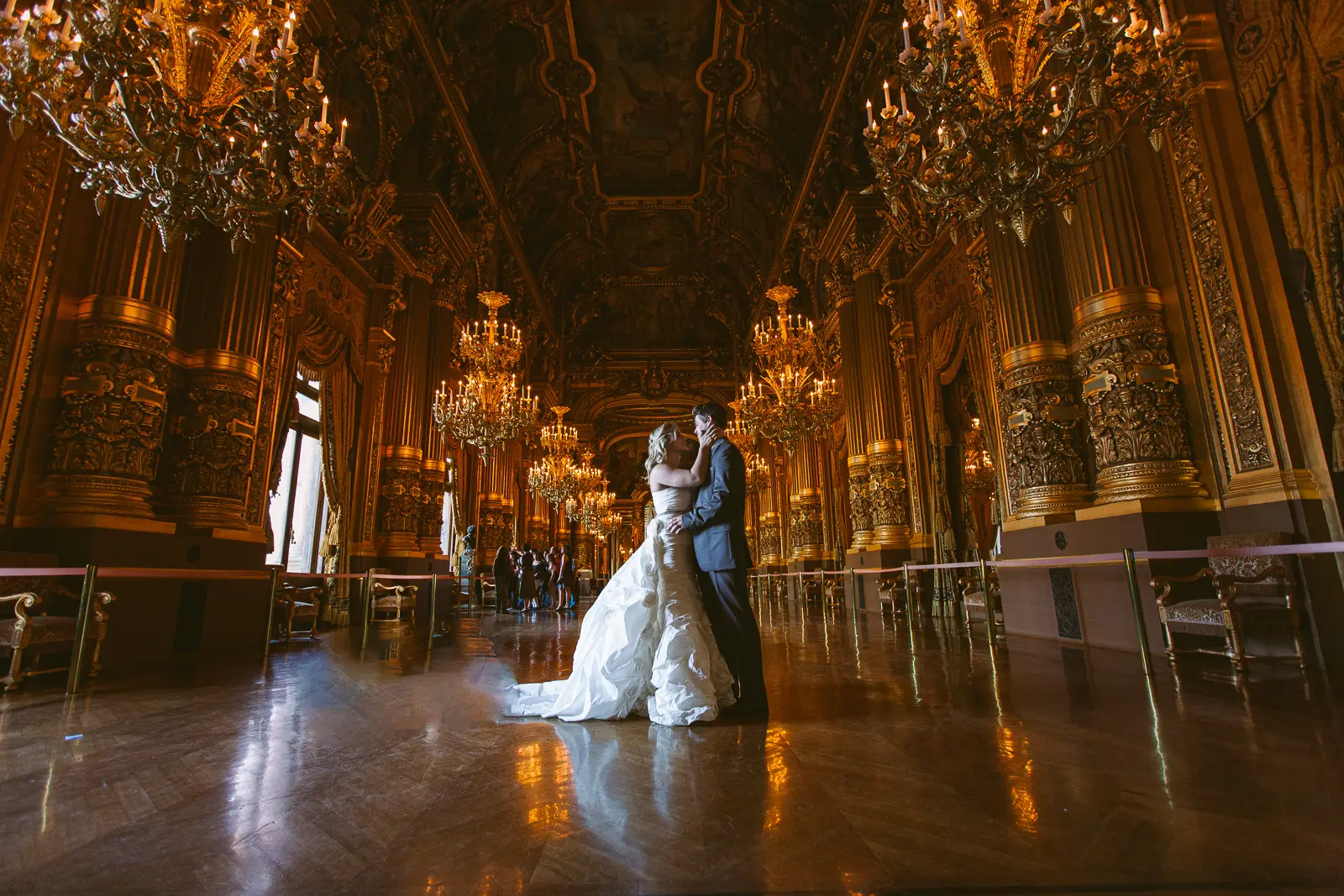
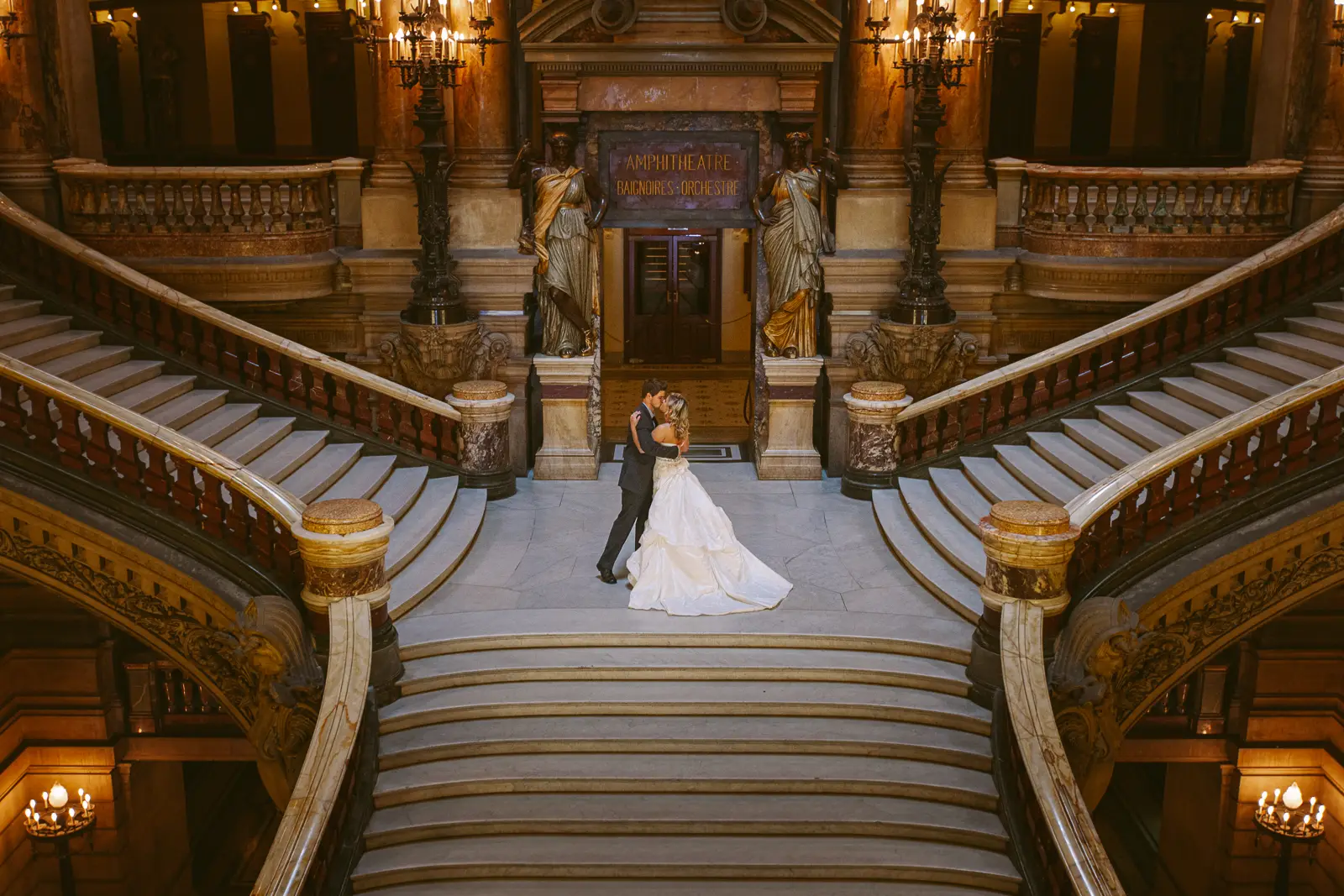
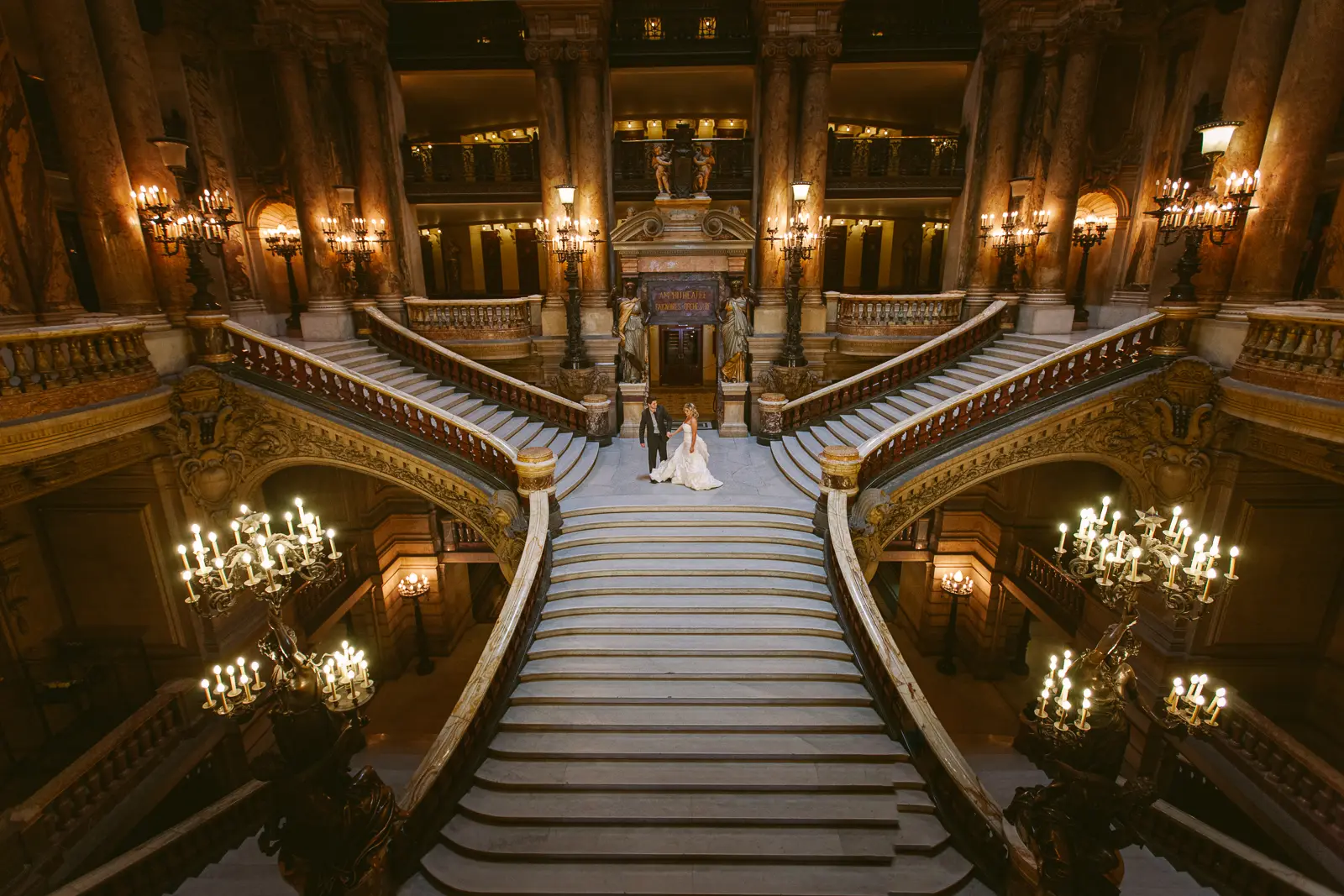
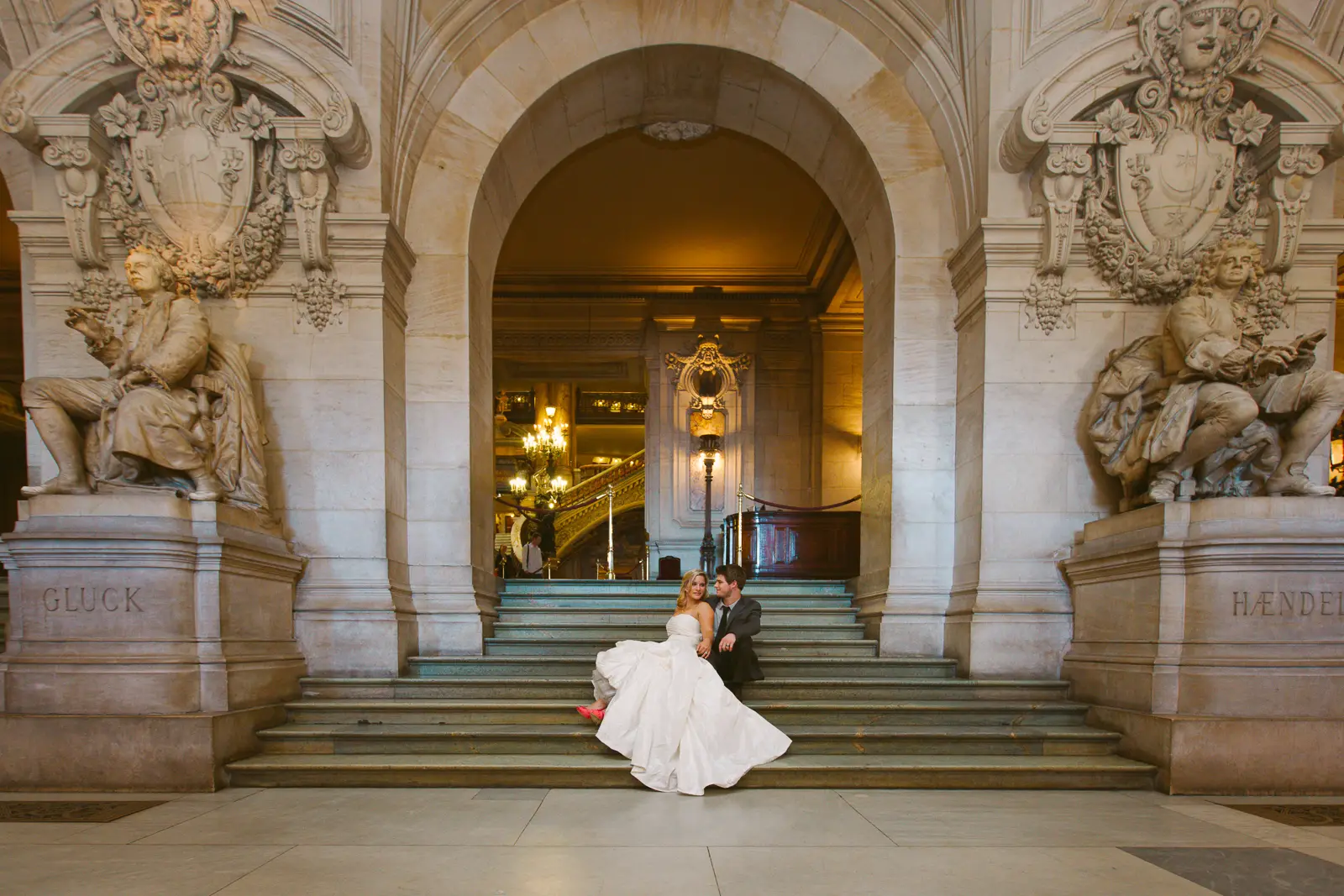
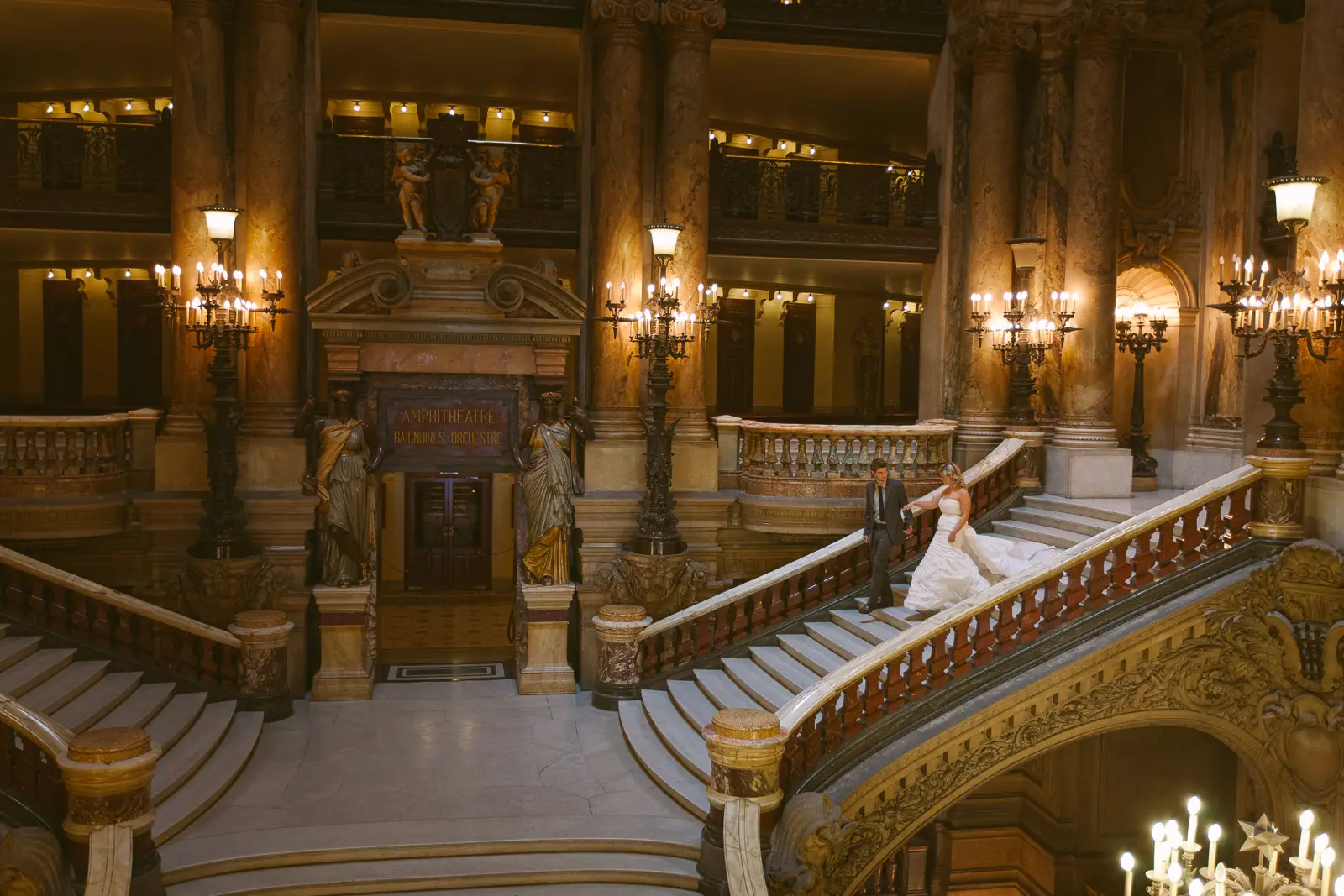
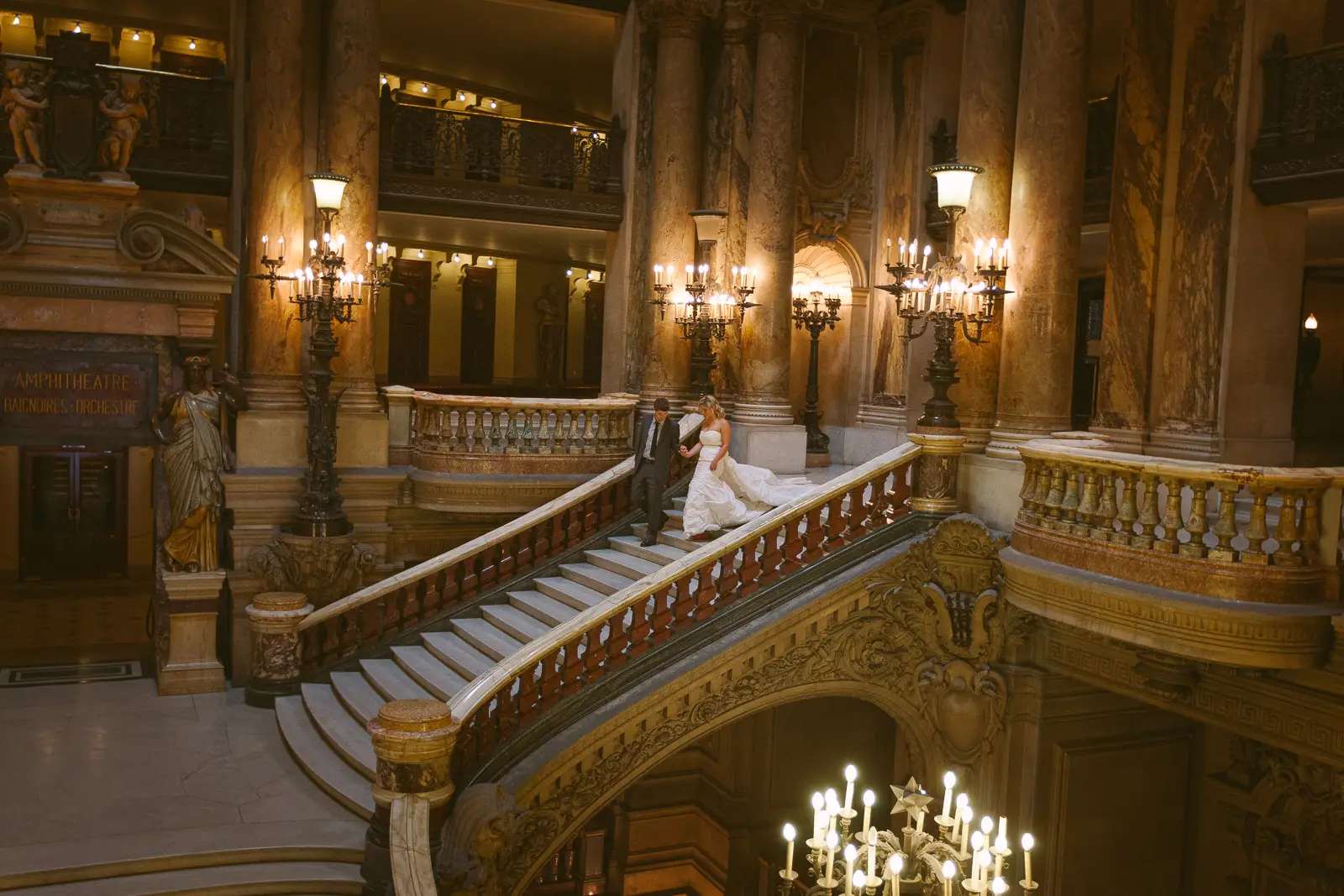
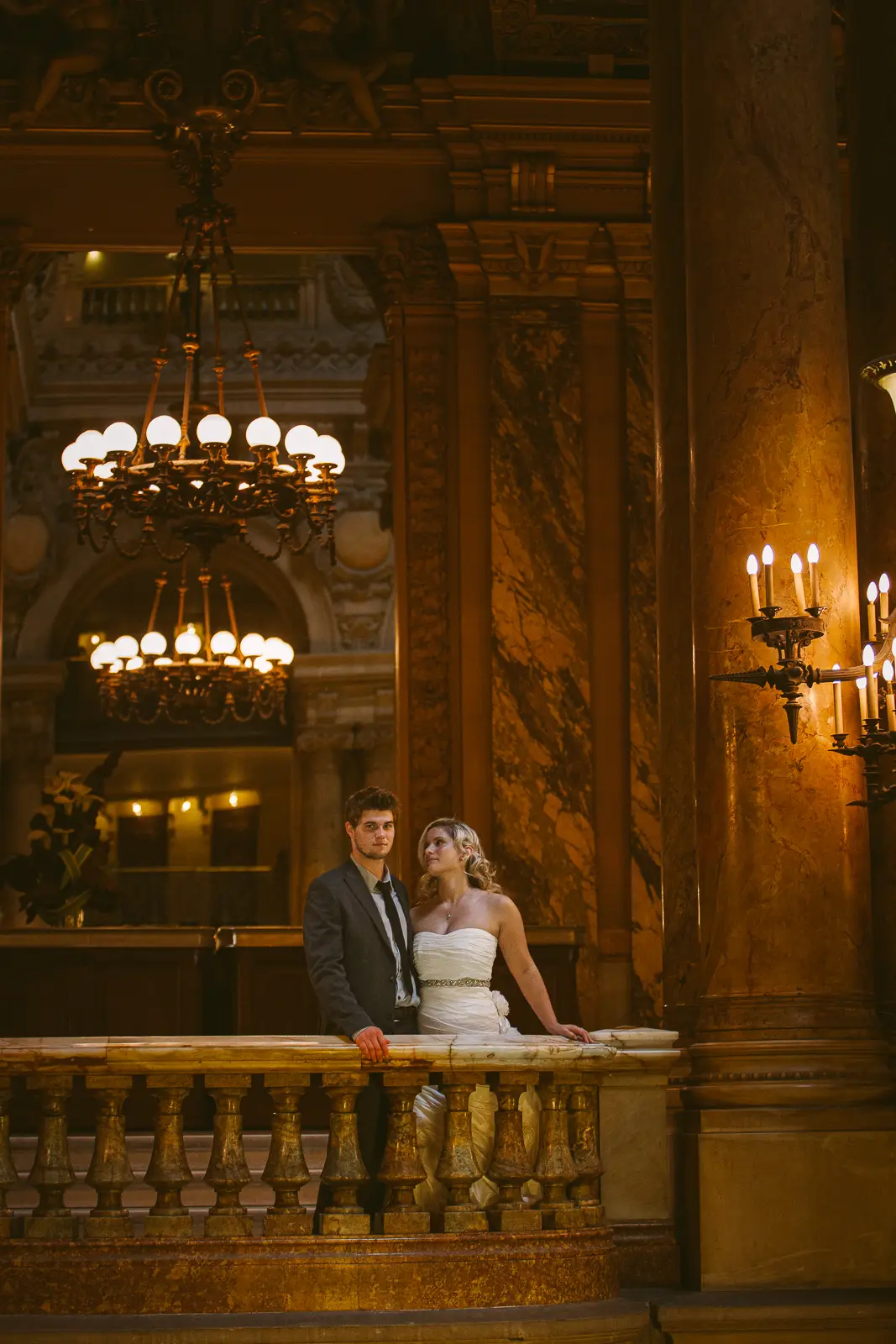
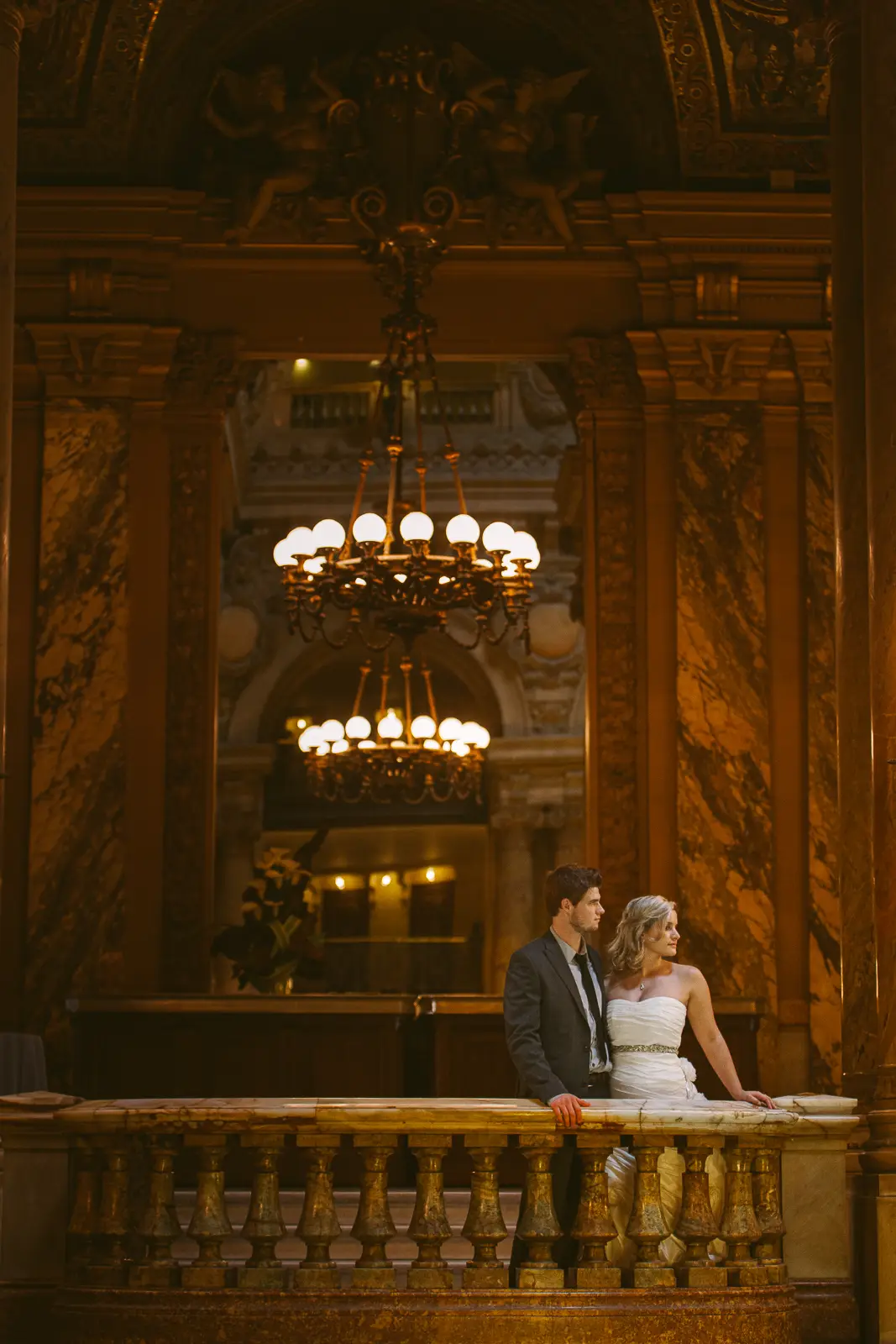
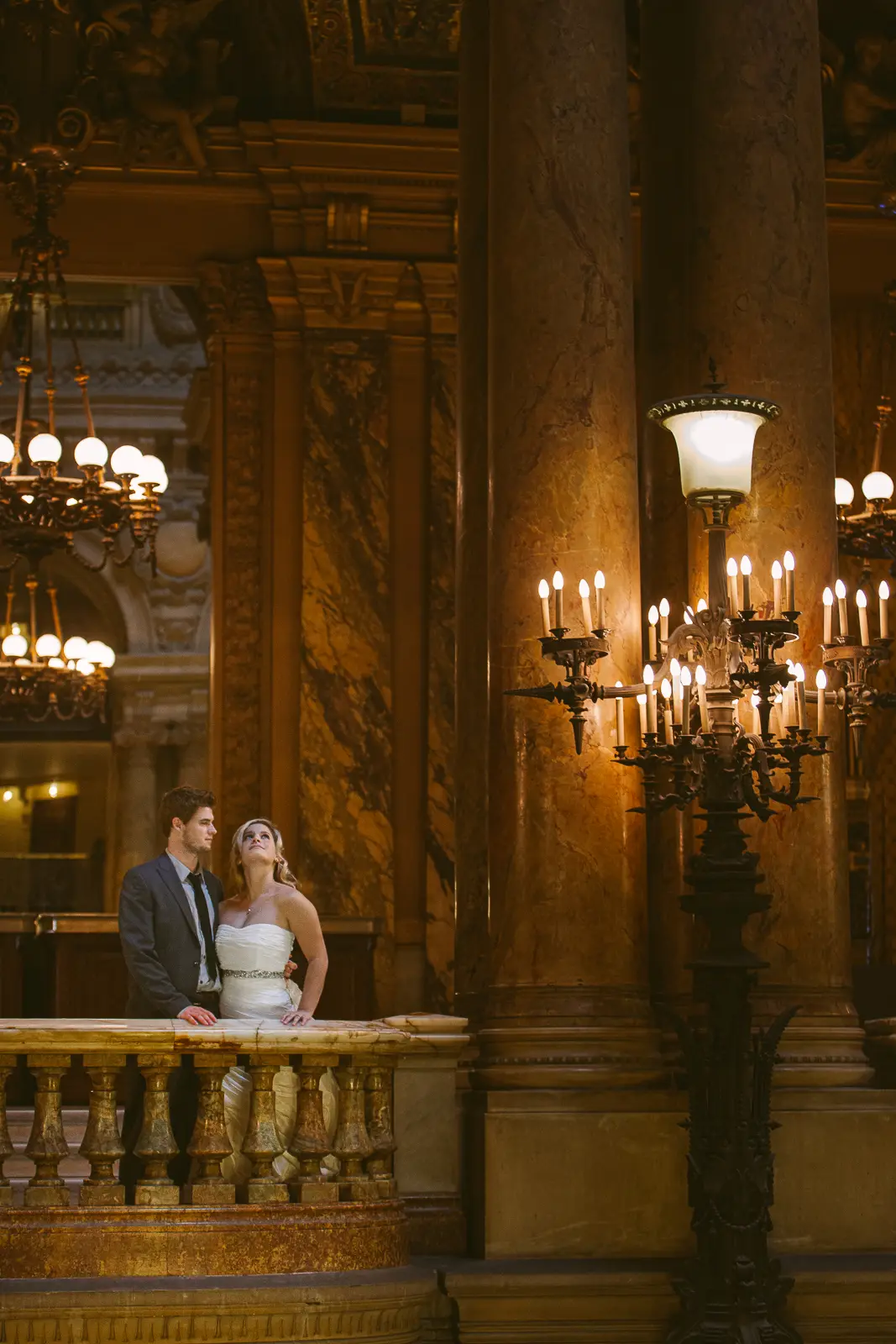
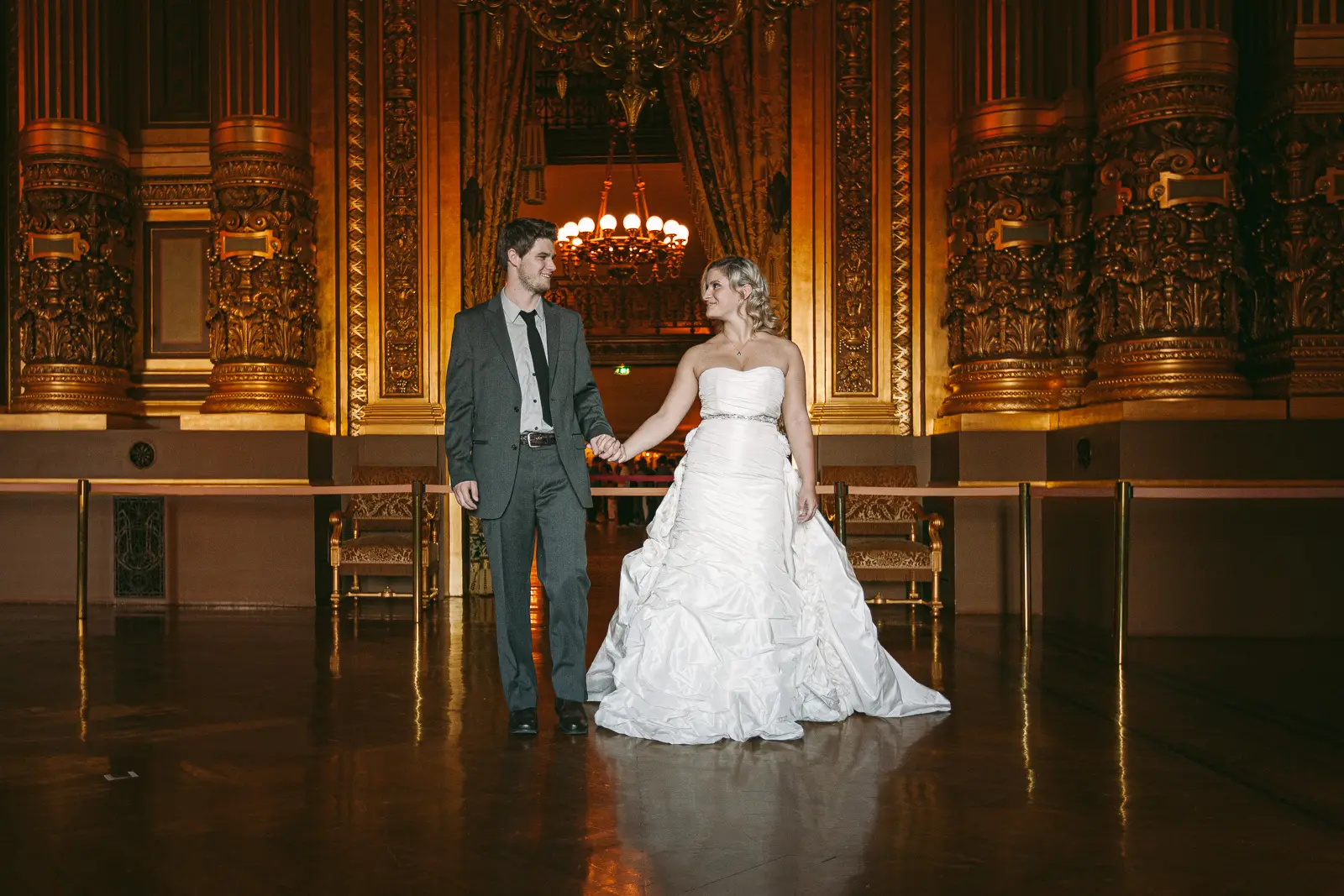
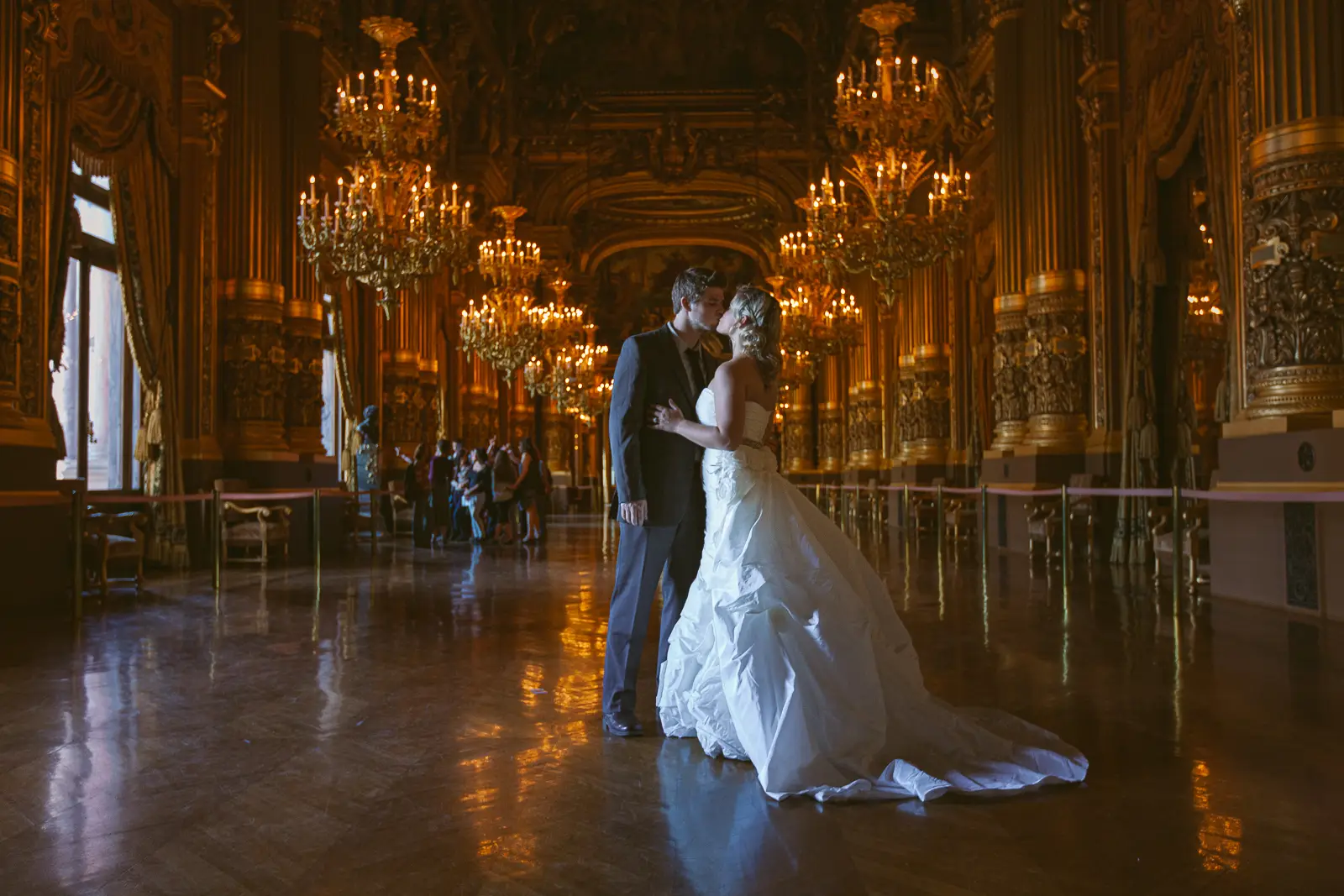
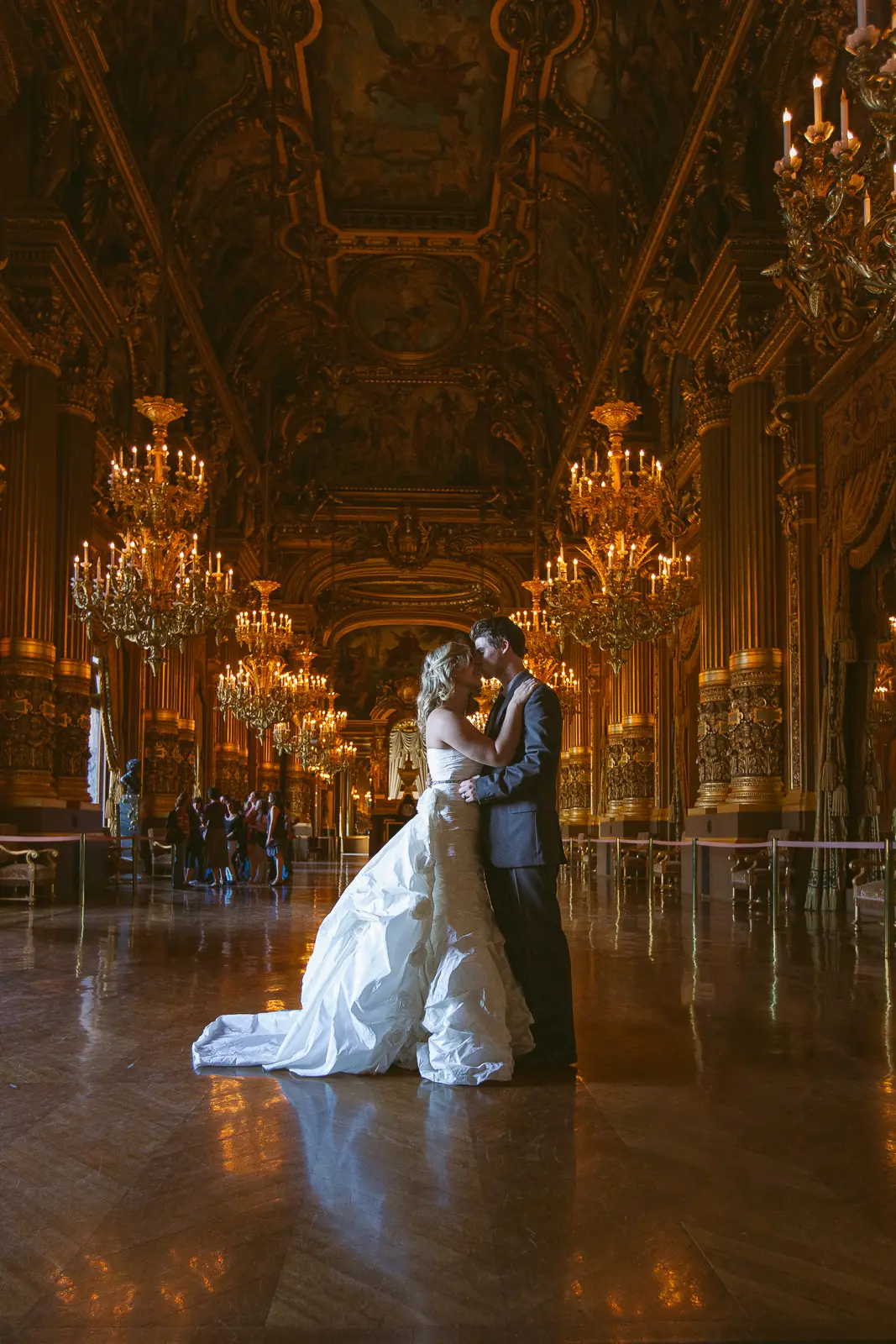
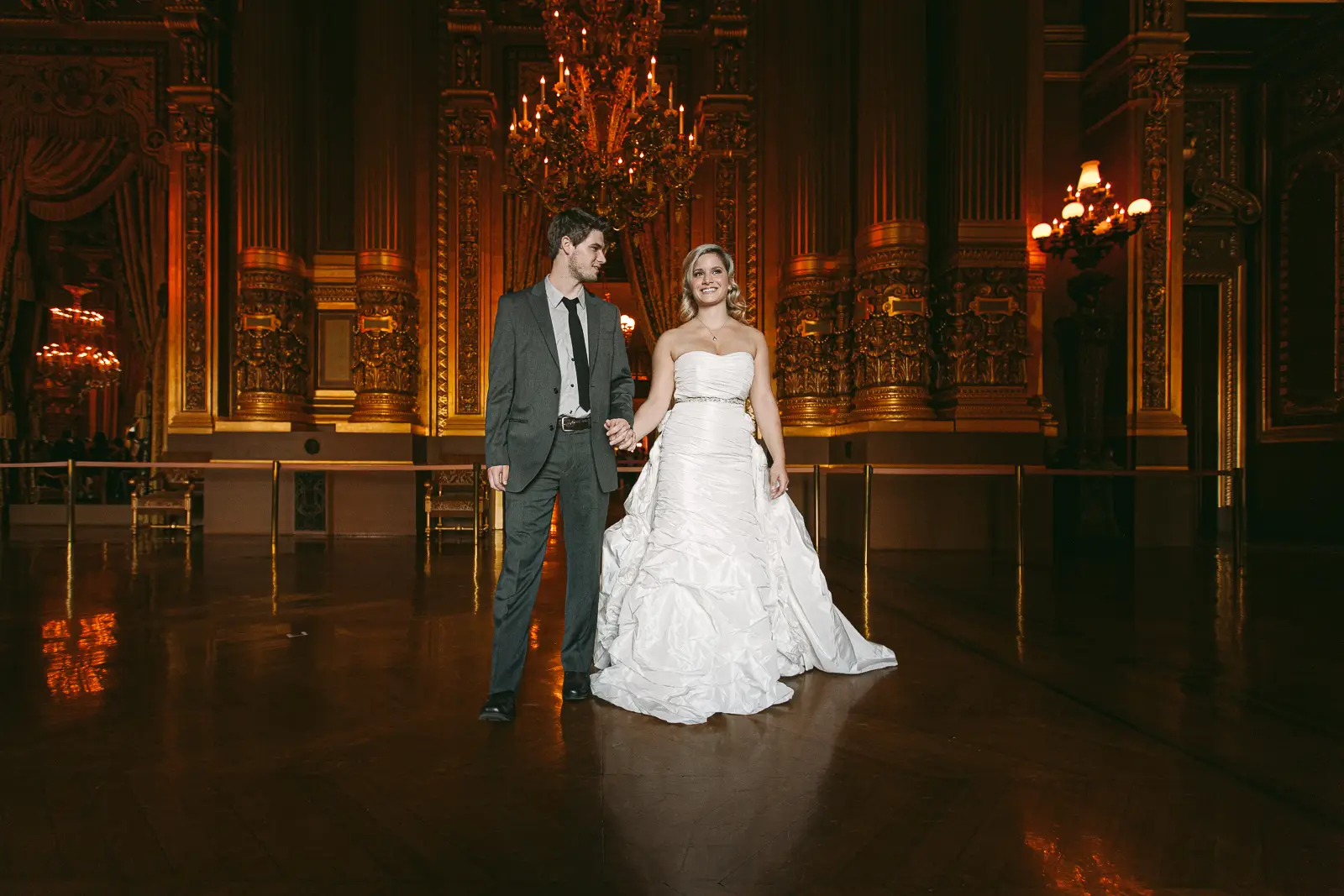
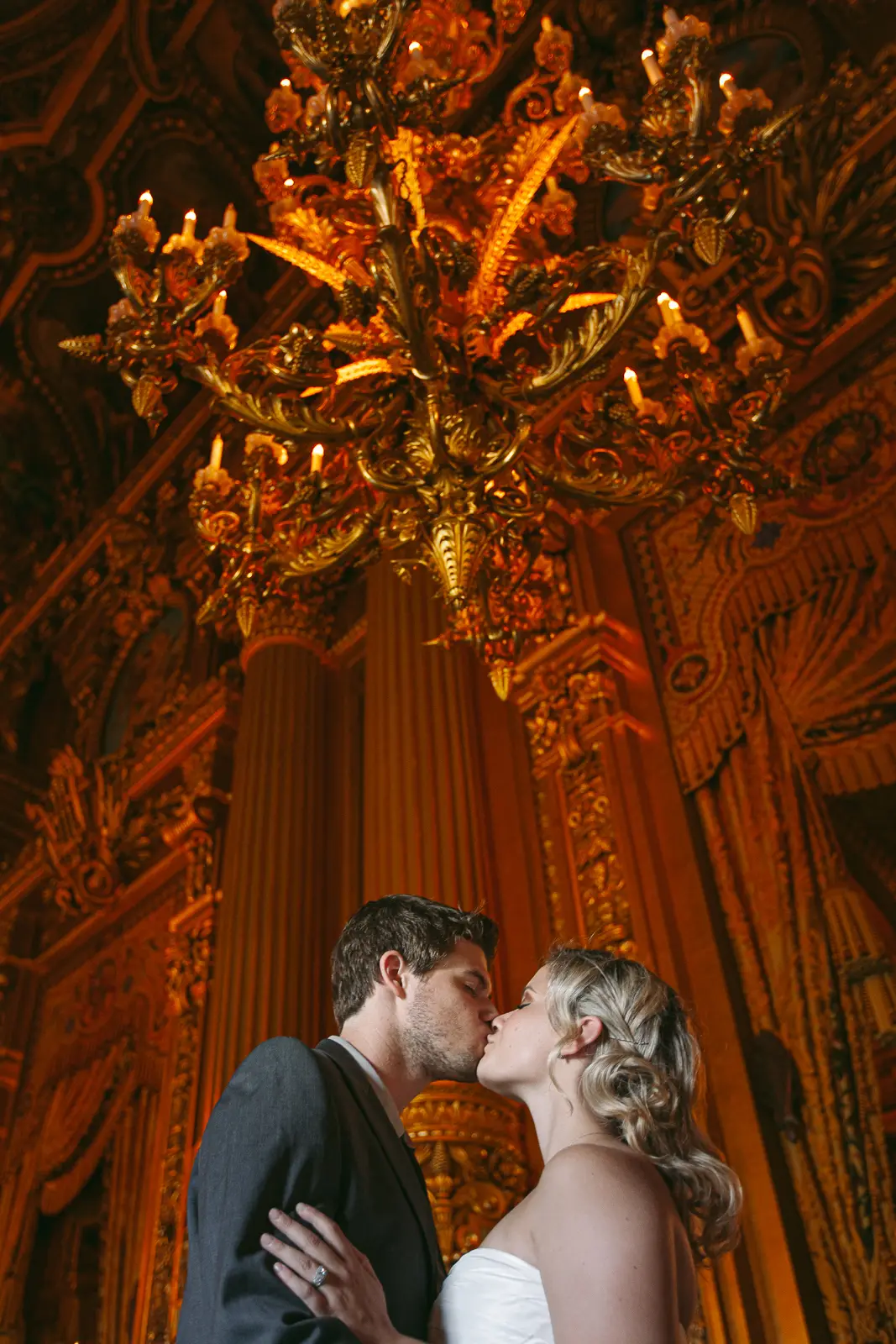
Palais Garnier is not a location that needs much decoration. The architecture already does most of the visual work. The scale of the staircase, the deep red and gold details, polished marble and reflected light give each photograph a sense of occasion before the couple even starts moving through the space.
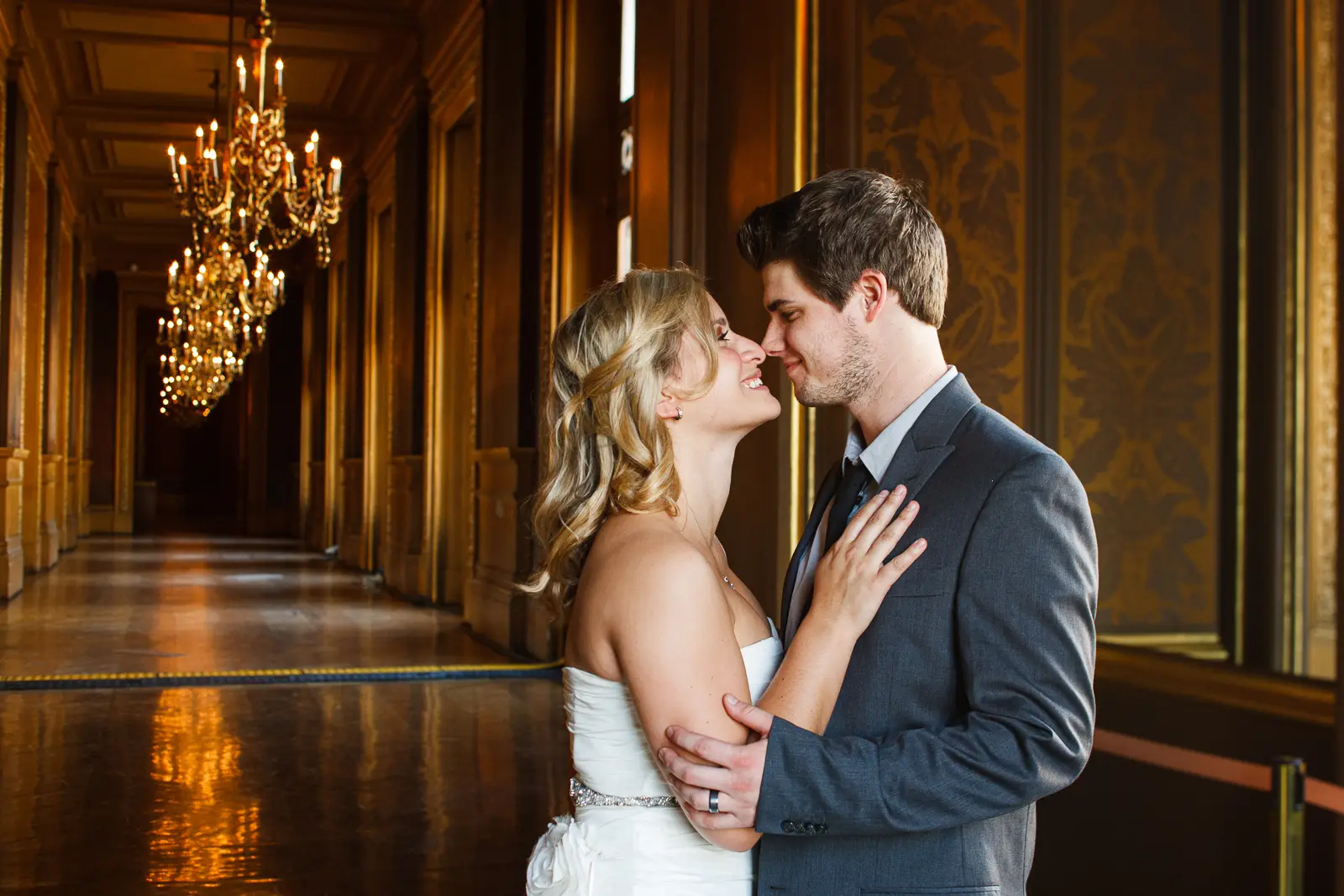
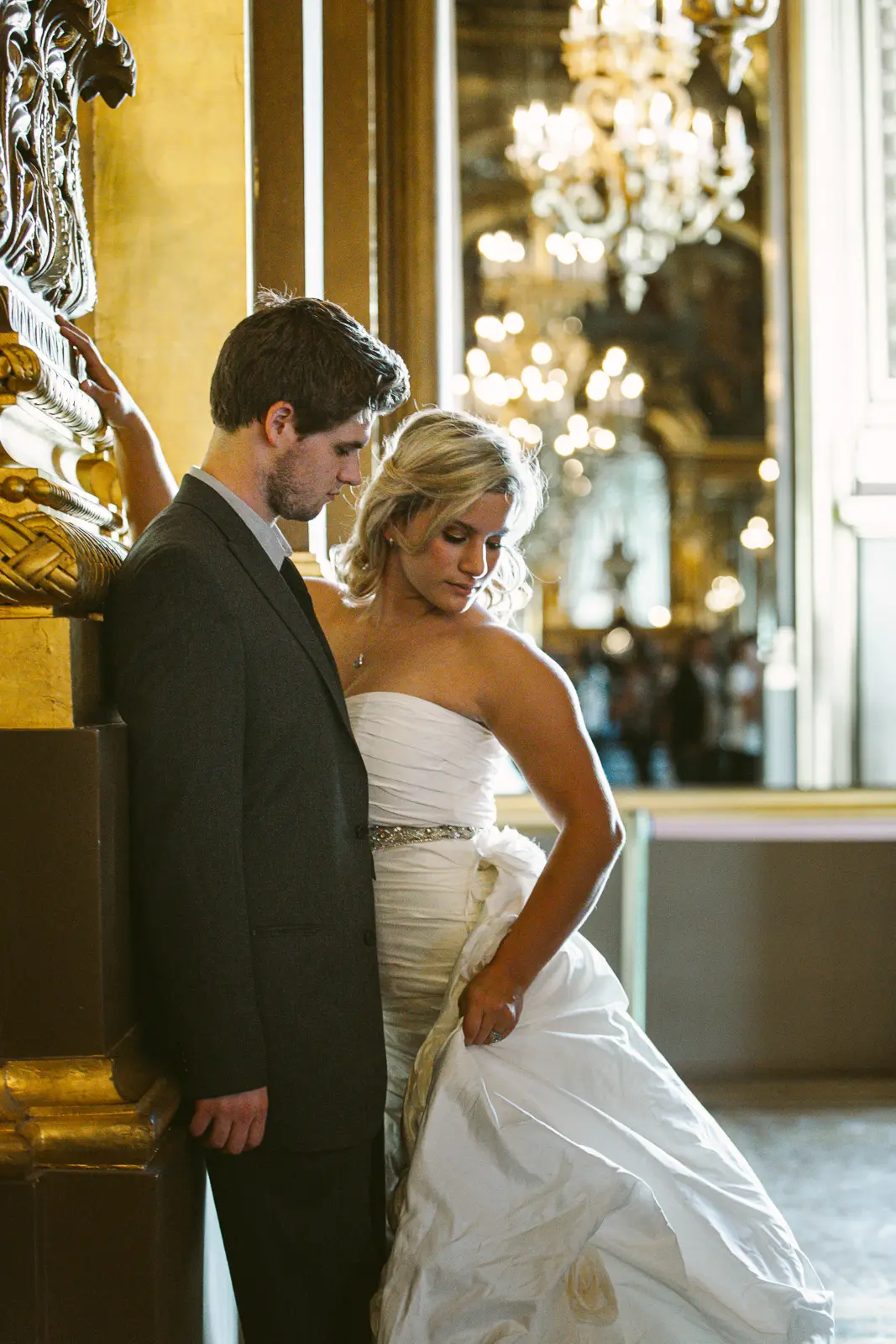
For Tabitha and Nathan, the point was not to make every frame look formal. The grandeur of the building gave us the editorial structure, while their own interaction brought the photographs back to something personal. Between the more composed portraits there was movement, conversation, laughter and the quieter moments that make a real pre-wedding story feel like more than a fashion shoot.
That balance matters in a location like this. If every image is posed too heavily, the building can overpower the couple. If everything is photographed too casually, you lose the reason for choosing Palais Garnier in the first place. I wanted both: strong architectural portraits and photographs that still felt like Tabitha and Nathan.
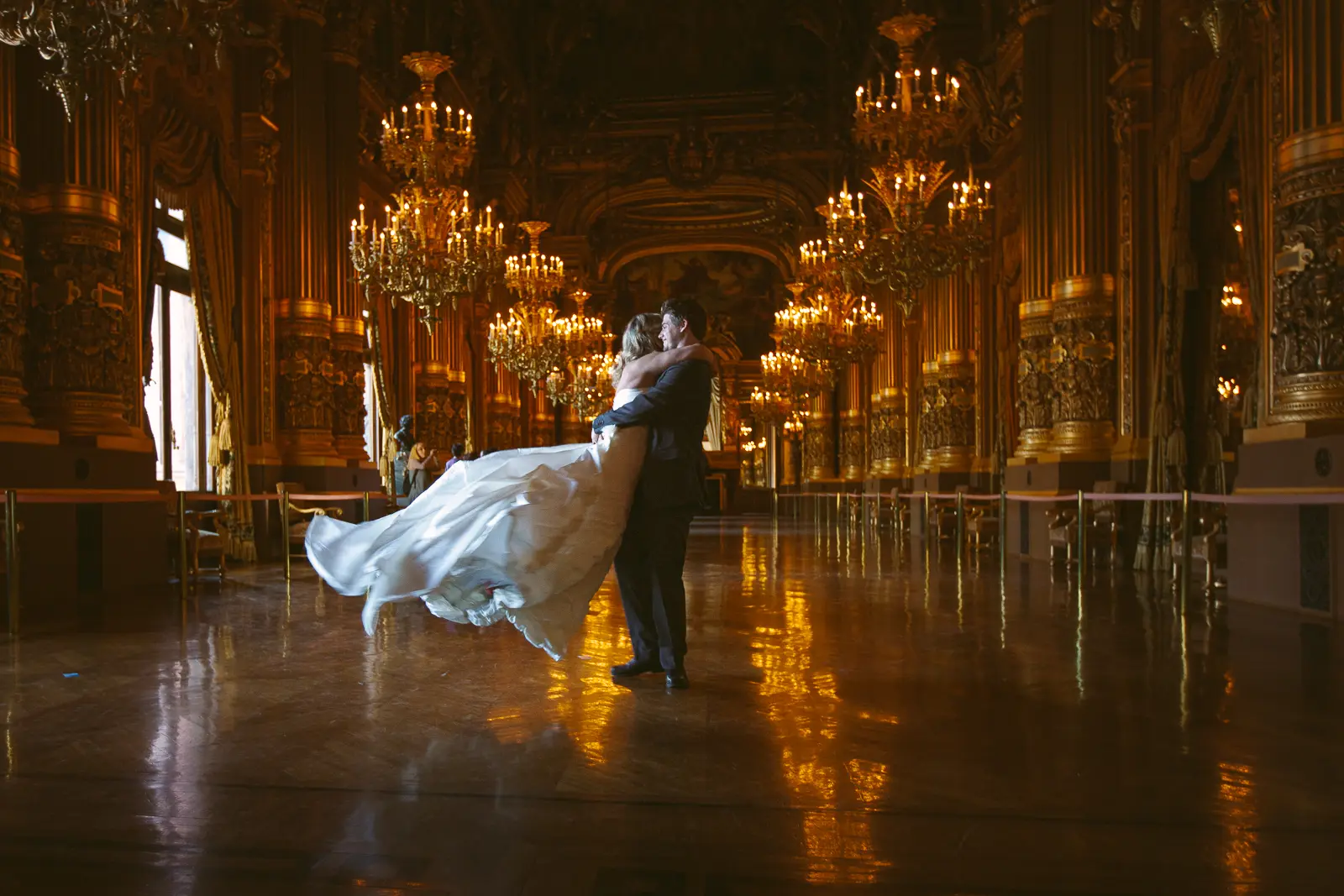
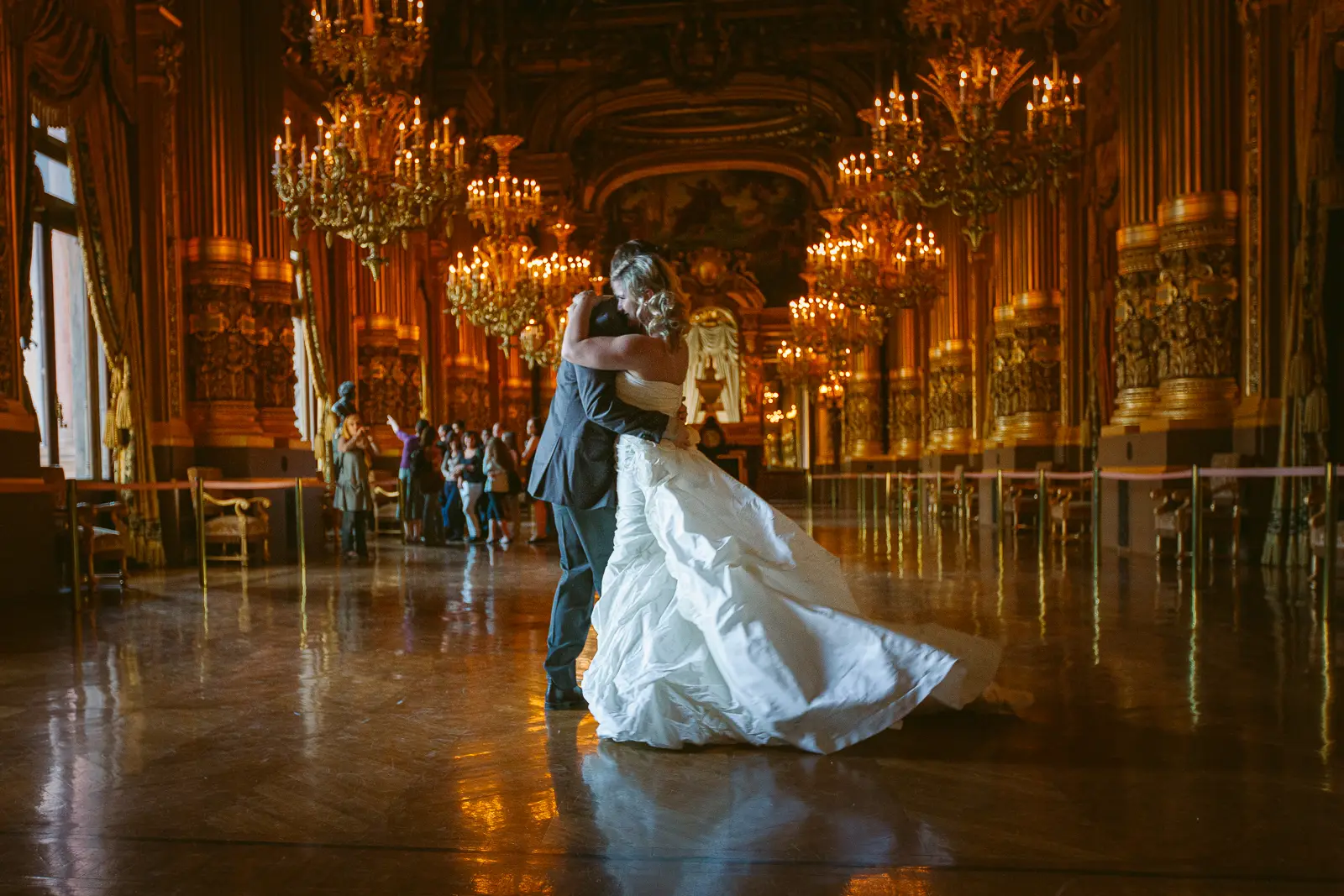
The live story describes them laughing, dancing and whispering between the more formal frames, and those moments matter just as much as the staircase portraits. They break the visual perfection of the room in a good way. You still see the Opera, but the photographs stop being only about the Opera and become about two people experiencing it together.
02
One building, several completely different photographic worlds.
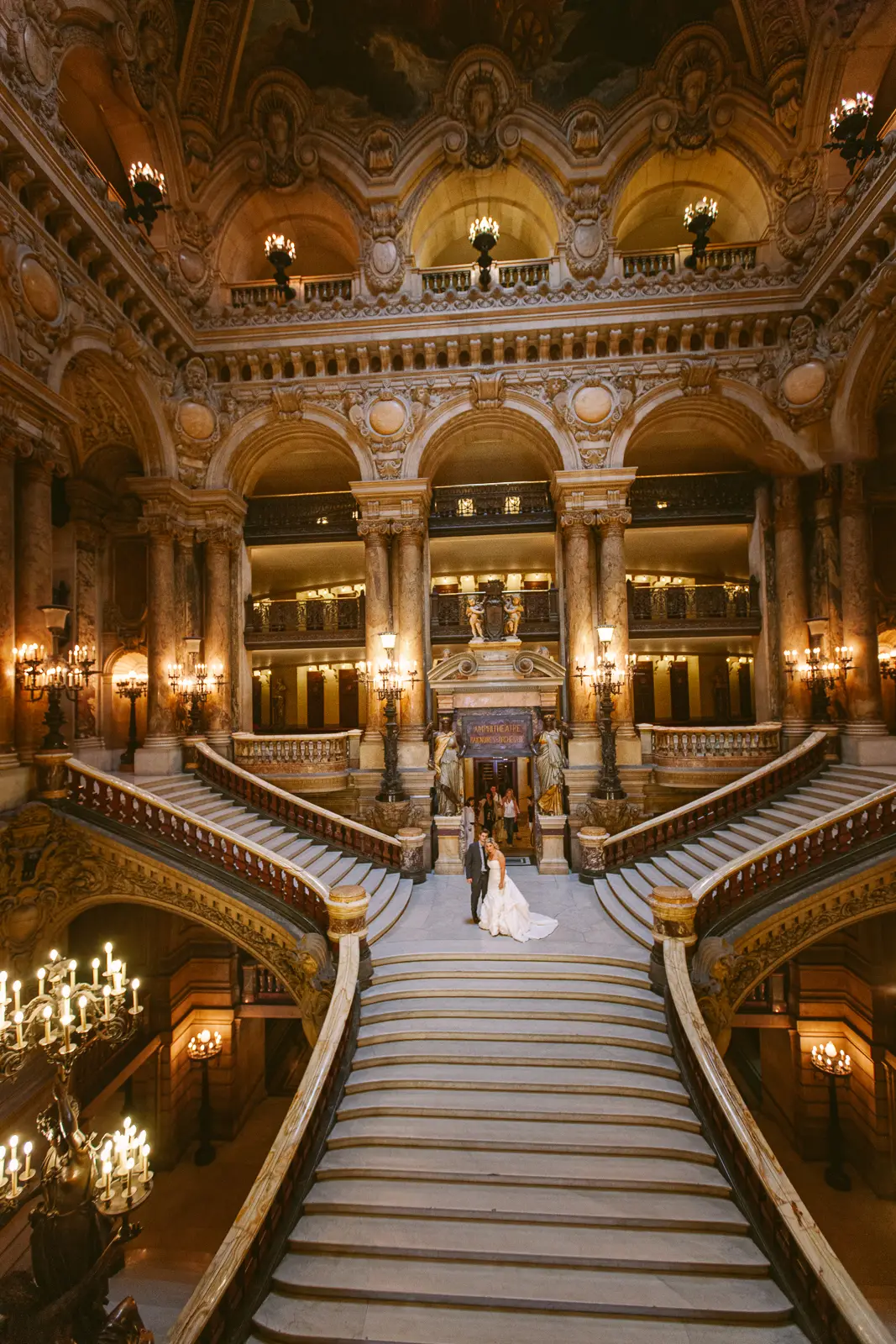
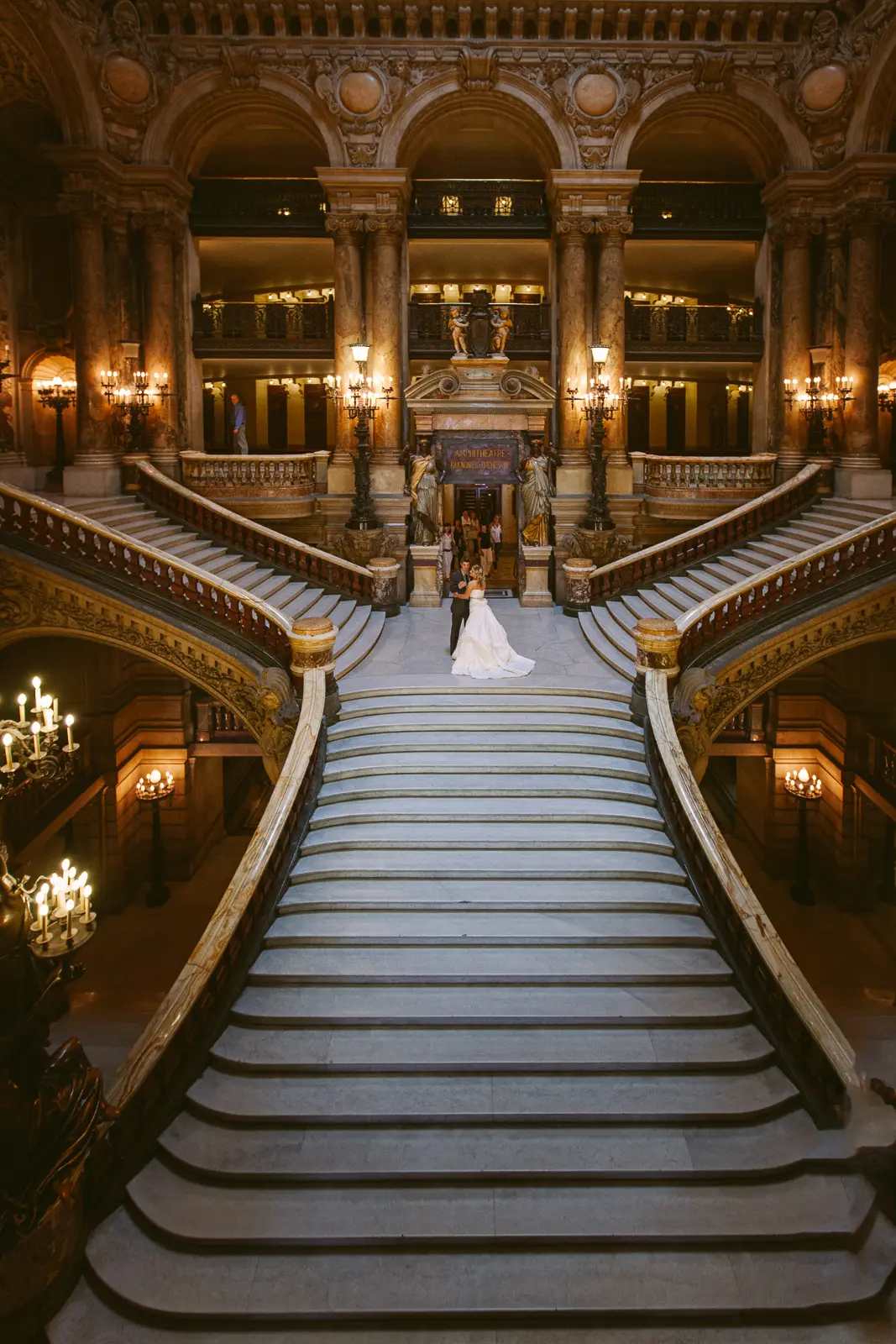
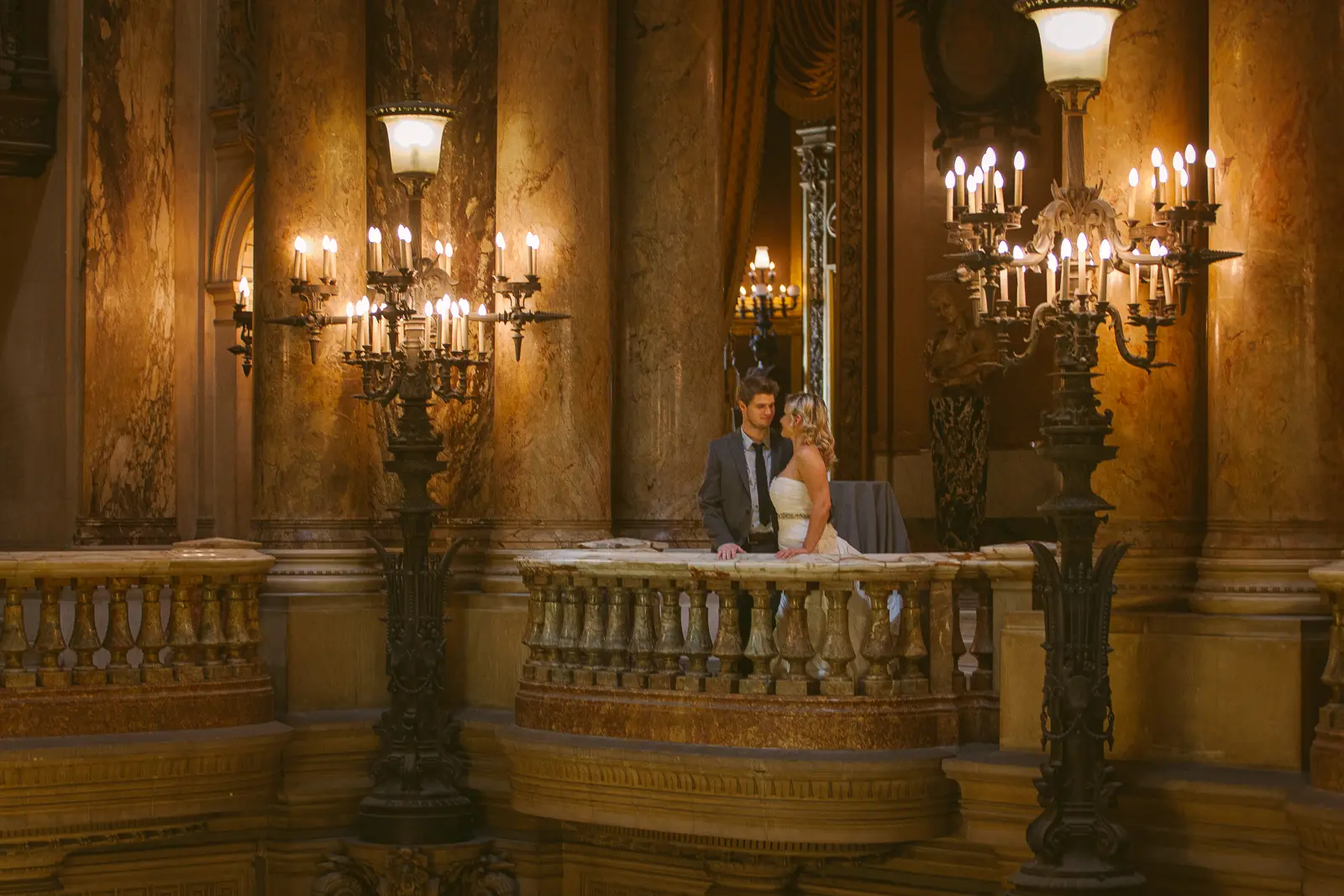
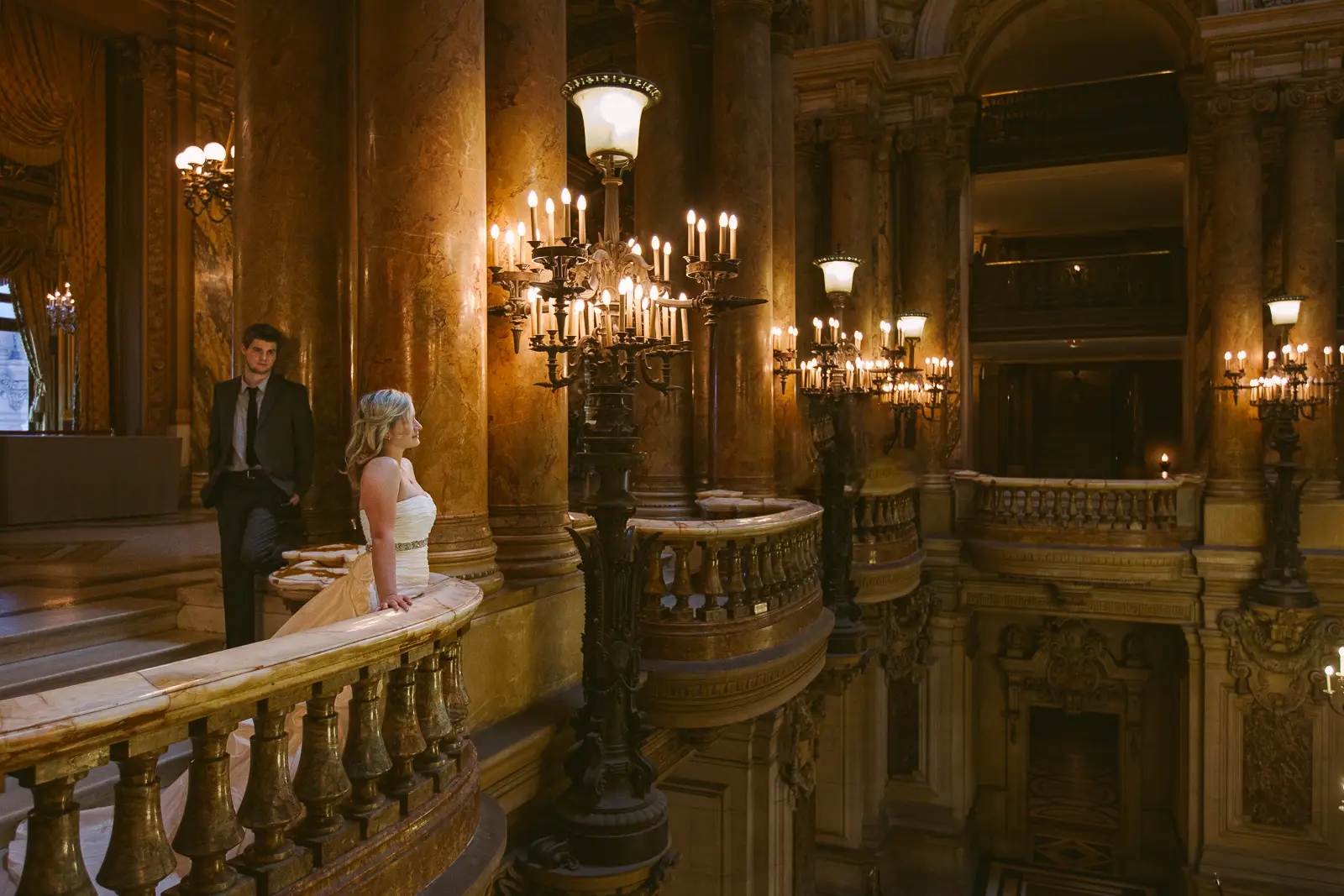
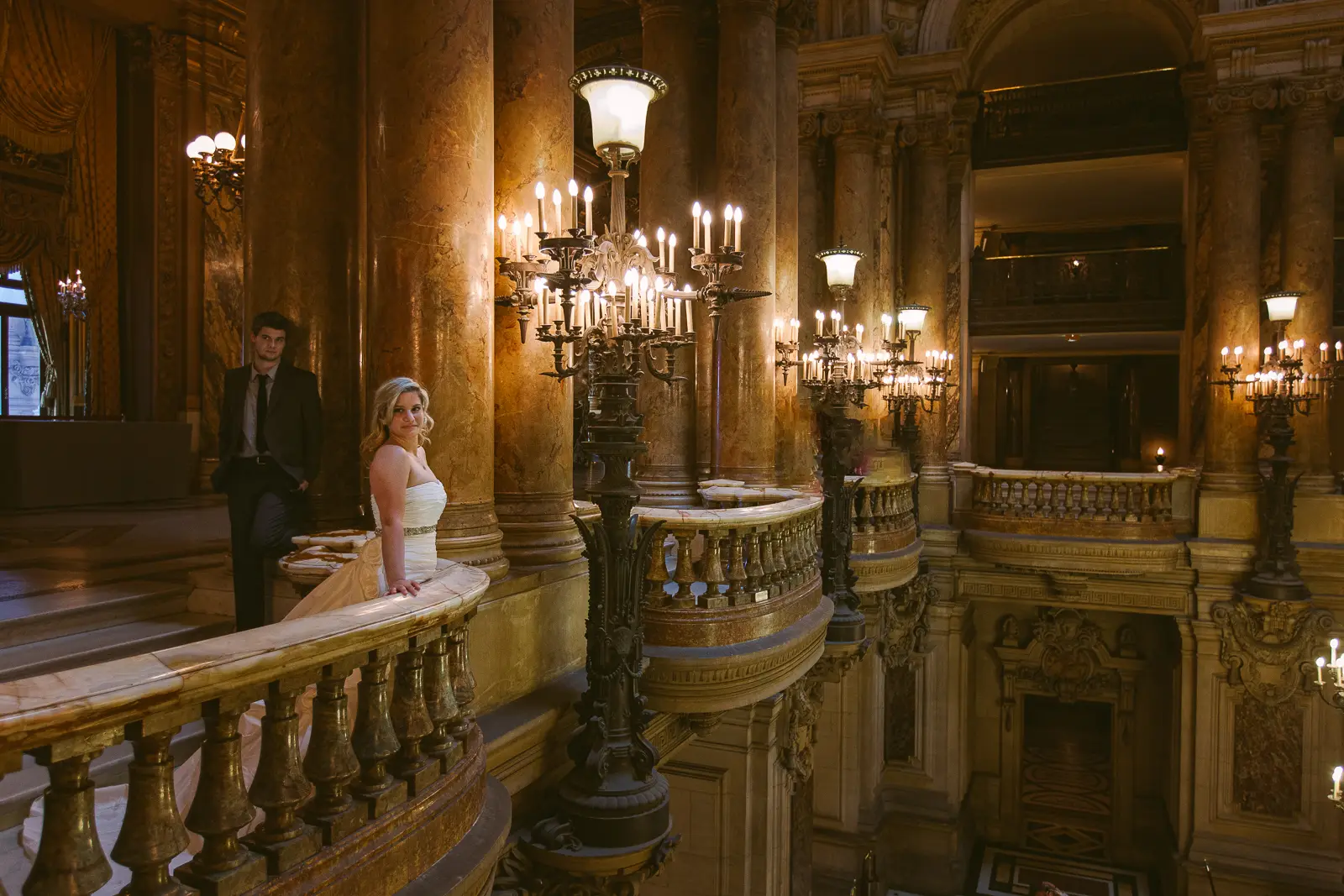
The grand staircase is the obvious starting point because it gives scale and symmetry, but it is only one part of the Opera. Balustrades, landings, corridors, windows, chandeliers and mirrored details let the photographs change from wide architectural frames to close portraits without leaving the interior.
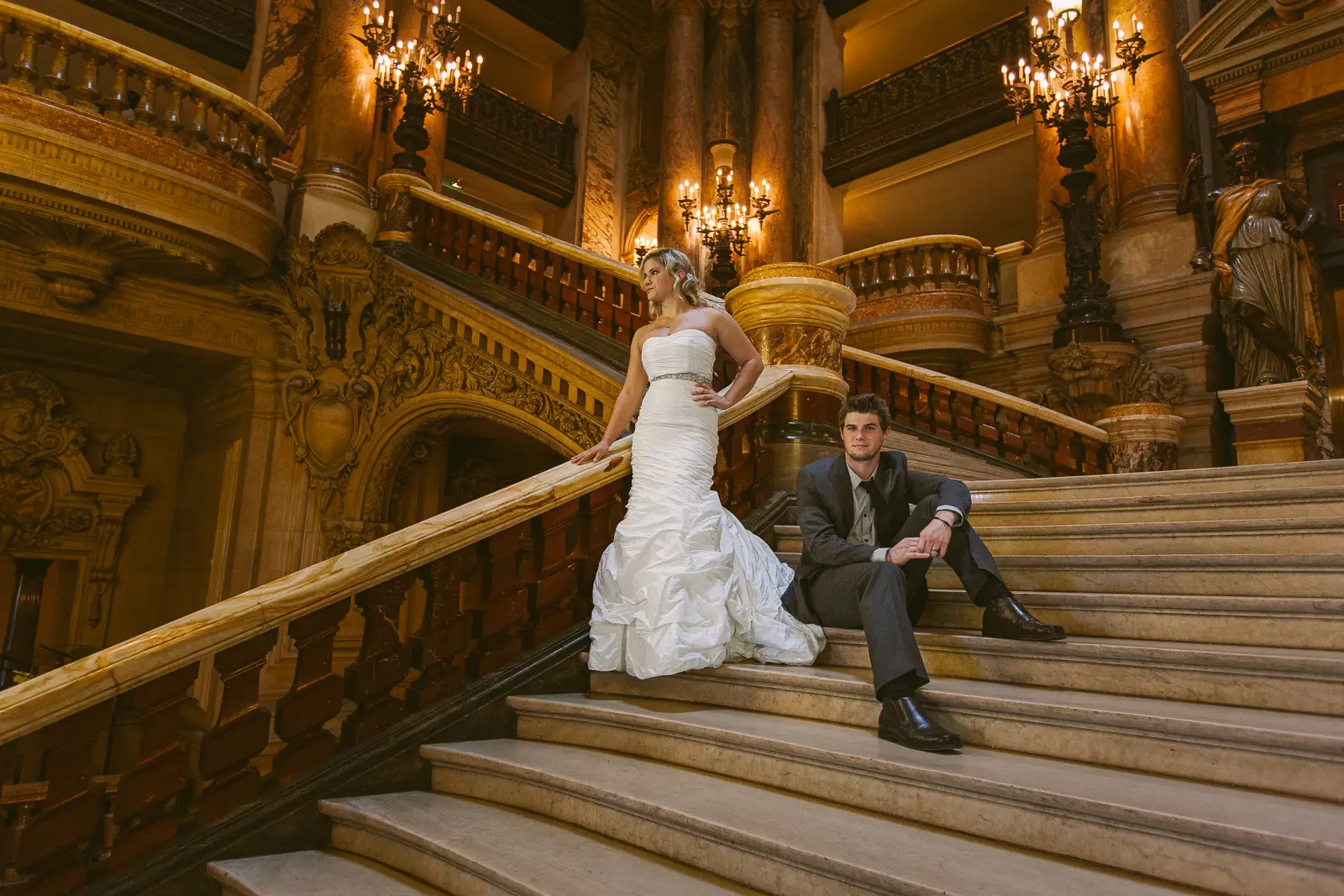
The building also gives a useful contrast between hard architectural lines and softer movement. A flowing dress can cut across the rigid geometry of a staircase; a quiet portrait can sit inside a frame full of gold and marble without needing extra props. For couples who want something more formal than an Eiffel Tower walk but still recognisably Parisian, that is a strong combination.
Light is part of the reason the interior photographs so well. Earlier in the day, window light can be softer and more directional. Later, reflections from chandeliers, mirrors and polished surfaces become more noticeable. The exact conditions vary, but the Opera gives enough visual depth that the session does not depend on one single lighting setup.

03
Dress for the scale of the room, not just for Paris outside.
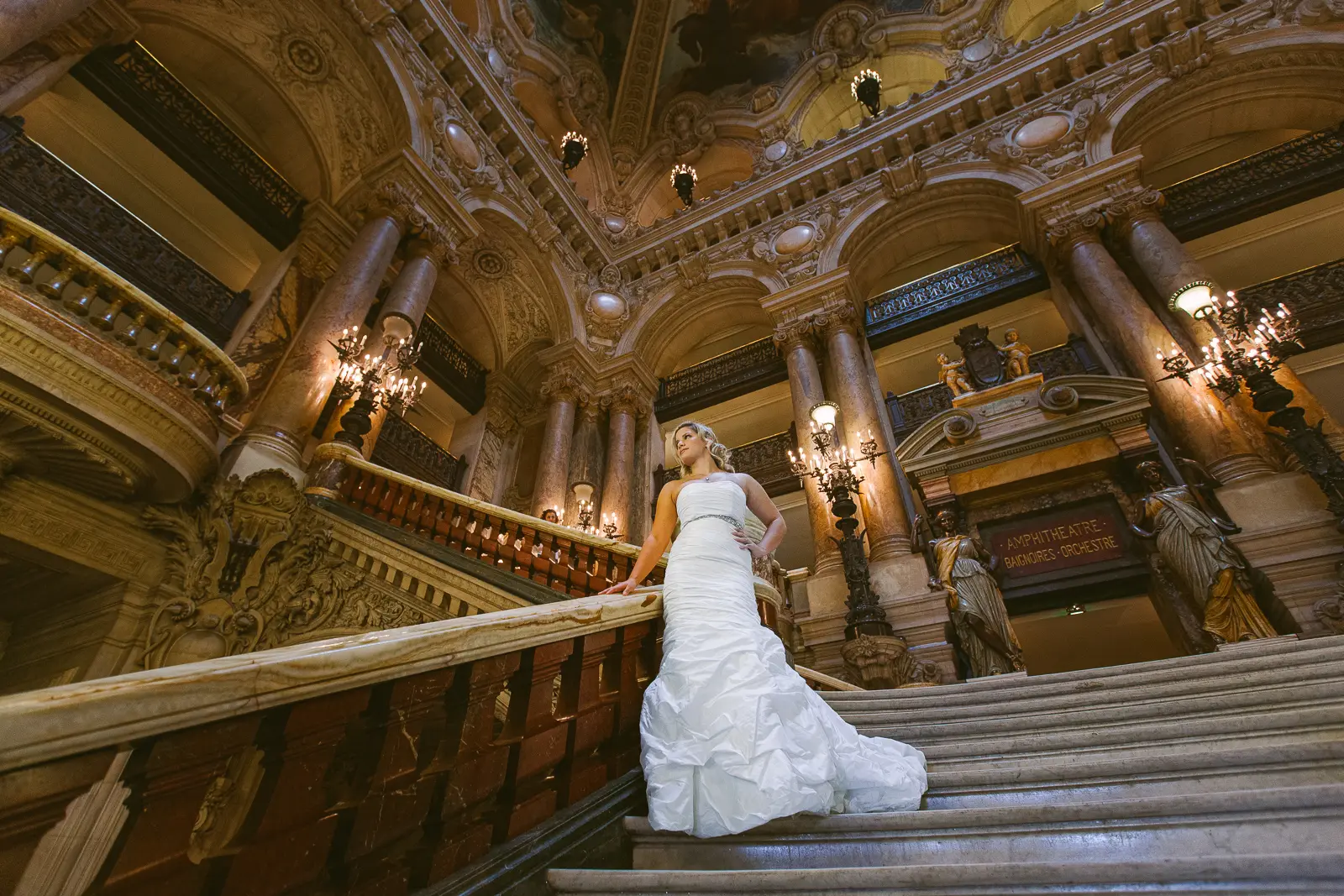
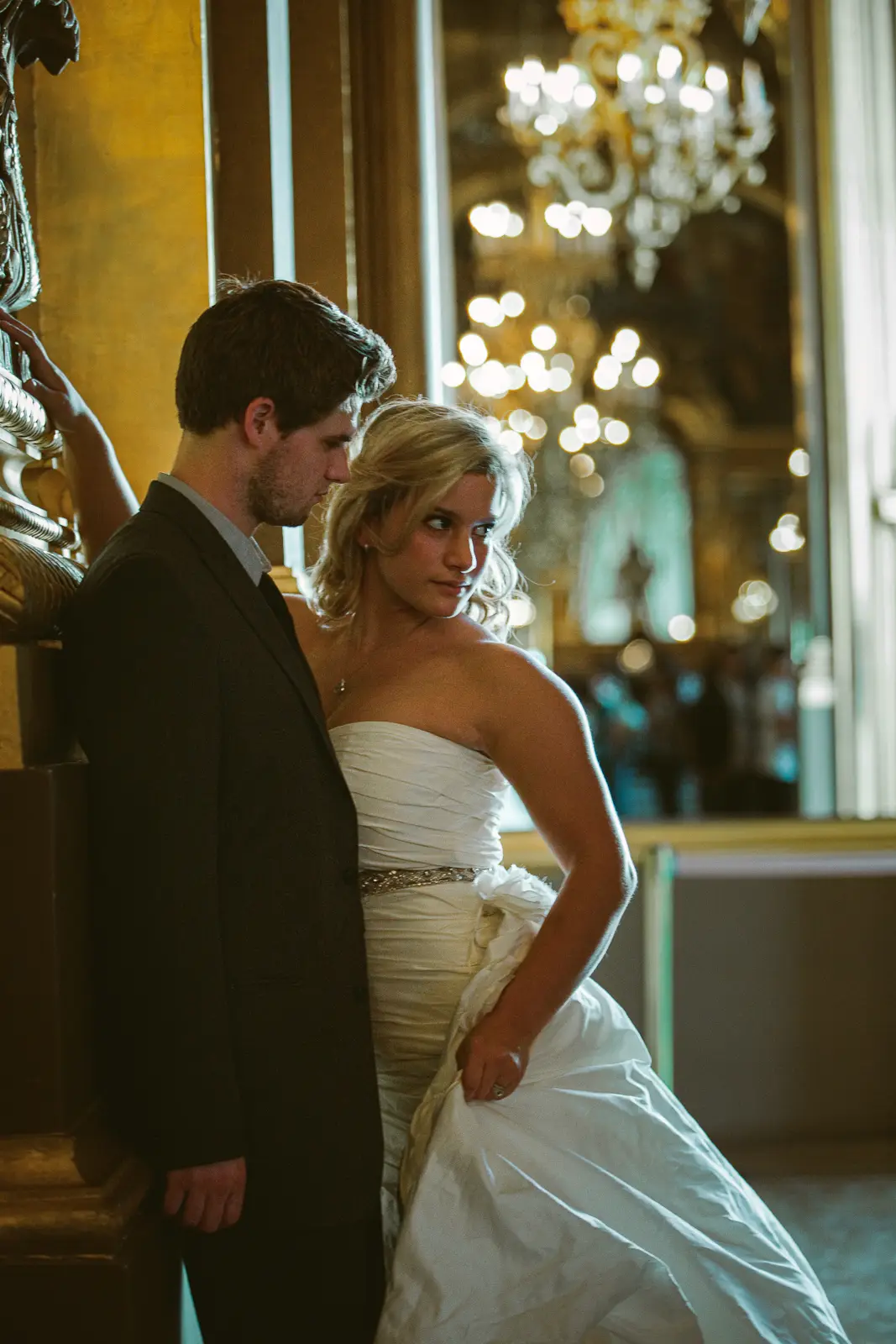
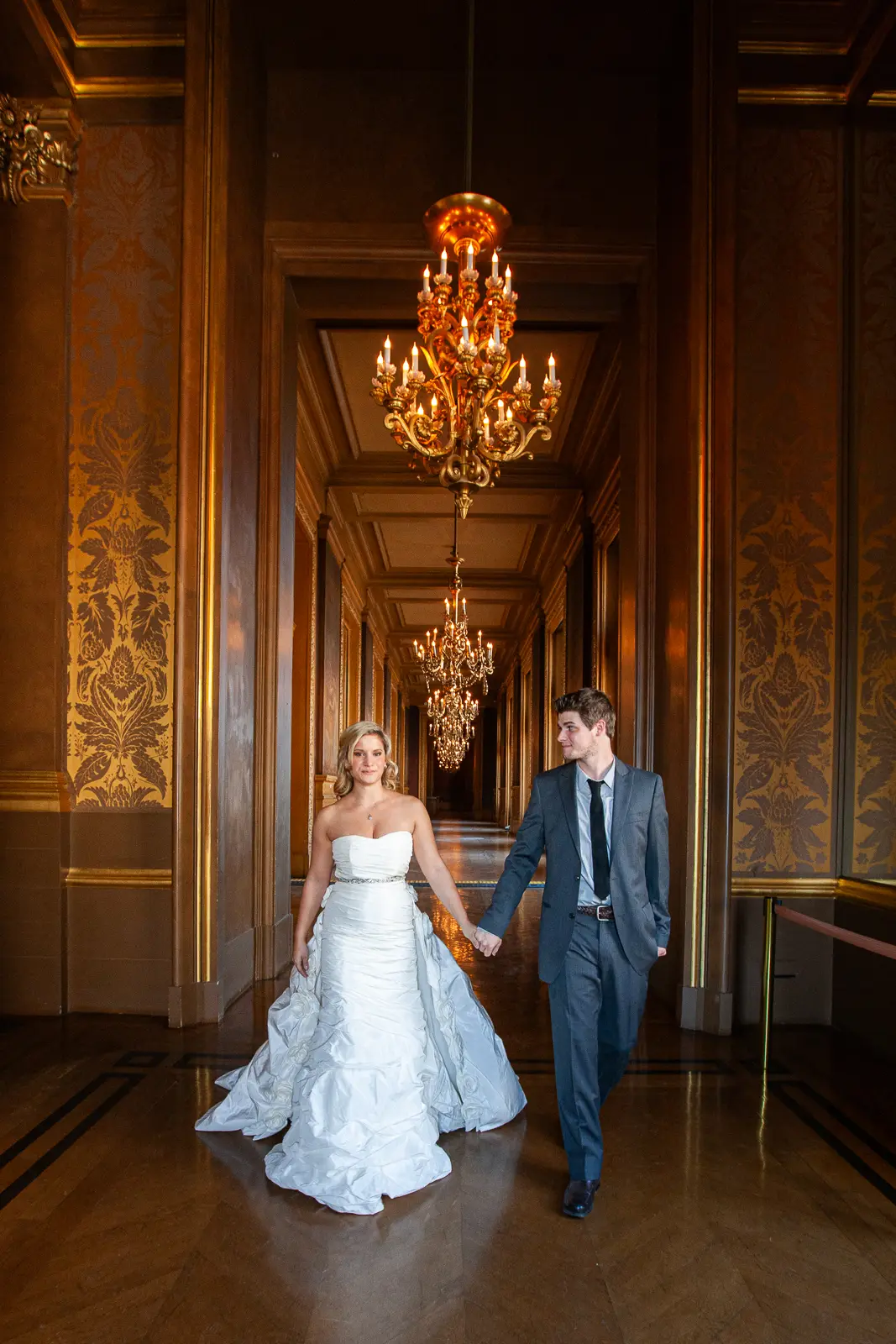
Palais Garnier rewards clothing with shape and presence. Tabitha's flowing gown worked naturally with the staircase and the movement through the rooms, while Nathan's tailored suit kept the look clean against a very decorative background.
That does not mean every couple needs a ball gown or black tie. The useful principle is simpler: the clothes should not disappear inside the architecture. Fabrics with movement, a strong silhouette and details that hold their own against gold, marble and red interiors tend to photograph well here.
I would also keep the number of outfit changes realistic. An interior session is valuable because you can spend time actually photographing rather than repeatedly stopping. If a second look is important, it makes sense to connect the change with a second location later in the day rather than interrupting the strongest part of the Opera coverage.
04
Access comes first. The rest of the Paris route comes second.
The most important practical point is permission. Palais Garnier requires advance arrangements for photography, and available times can fill. I would not build a complicated Paris schedule first and then try to squeeze the Opera into it. Confirm the interior access, then design the rest of the day around that fixed point.
An earlier session is usually the cleaner option. There are fewer visitors, the building feels calmer and the window light is often easier to work with. It also leaves the rest of the day available if you want outdoor Paris photographs afterwards.
That second location should add something the Opera cannot. The Louvre can bring a more open architectural feeling, Pont Alexandre III gives river and bridge views, and the Tuileries can soften the gallery with greenery and movement. The goal is not to collect landmarks. It is to make the second part visually different enough to justify the travel time.
I also leave breathing room around the Opera booking itself. Entry procedures, visitor flow and simply moving through a large historic building can take longer than expected. A schedule that looks efficient on paper can become stressful very quickly if every transition is timed to the minute. A little margin keeps the session calm and gives us room to react to the light and the spaces that are working best on the day.
Morning light or later in the day?
05
The building changes character as the light changes.
The live Opera story recommends going early, and there is a practical reason for that beyond simply avoiding people. Morning light coming through the windows is softer and calmer, which works beautifully for skin tones and for the pale marble of the staircase. It also makes it easier to create wider architectural photographs without constantly waiting for gaps in the background.
Later in the day, the visual character changes. The chandeliers, mirrors and polished surfaces become more noticeable and the photographs can feel warmer and more theatrical. Neither look is automatically better. If your priority is clean, timeless portraits with the architecture clearly visible, I would normally favour the earlier slot. If you want a stronger sense of atmosphere and glow, a later session can be very appealing.
The important thing is to decide what the Opera is supposed to contribute to the finished gallery. It should not just be another famous Paris location on a checklist. It can be the refined, architectural chapter of the day, and once that role is clear it becomes much easier to choose the right timing and what should come before or after it.
Adding a second Paris location

06
Contrast makes the complete gallery stronger.
The original story suggests combining Palais Garnier with another Paris location, and I think that works best when the second place does something visually different. The Opera already gives you rich interiors, symmetry, gold, marble and formality. Repeating the same mood somewhere else usually adds less than changing the rhythm completely.
The Louvre can work if you want cleaner exterior architecture and open space. Pont Alexandre III gives you the Seine, sky and a more expansive city feeling. The Tuileries Gardens soften everything with trees, paths and movement. Even a simple walk around Place de l'Opéra can give the final set a useful transition from grand interiors to real Paris streets.
I would not try to fit all of those into one session. Travel, traffic and changing locations can quietly consume the time that should be spent photographing. One carefully chosen second stop is normally enough. The aim is to finish with two distinct chapters that belong together, not a rushed collection of Paris landmarks.

07
Editorial structure, without turning the whole session into posing.
Palais Garnier is a place where direction helps. The architecture is too strong to ignore, so I will use the staircase, lines, mirrors and balconies deliberately when building the composition. That is the editorial side of the work.
But I do not want a gallery of thirty versions of the same formal portrait. Once the composition is set, I am looking for movement and interaction: walking, turning, adjusting a dress, looking away, laughing, or simply letting the couple settle into the space. Those transitions are often where the photographs become less perfect and more believable.
The result should feel polished enough for the location, but still recognisably yours. That is particularly important with a pre-wedding shoot because these photographs are not documenting a ceremony or reception. The personality has to come from the couple themselves.
What the photographs need to do
The Opera should feel grand, but the couple still has to remain the subject..
Palais Garnier can easily become the main character in every photograph. It is visually loud: gold, red, marble, mirrors, columns, staircases and chandeliers are competing for attention at the same time. The job is not simply to show the building. It is to use the building to give the couple scale, structure and atmosphere.
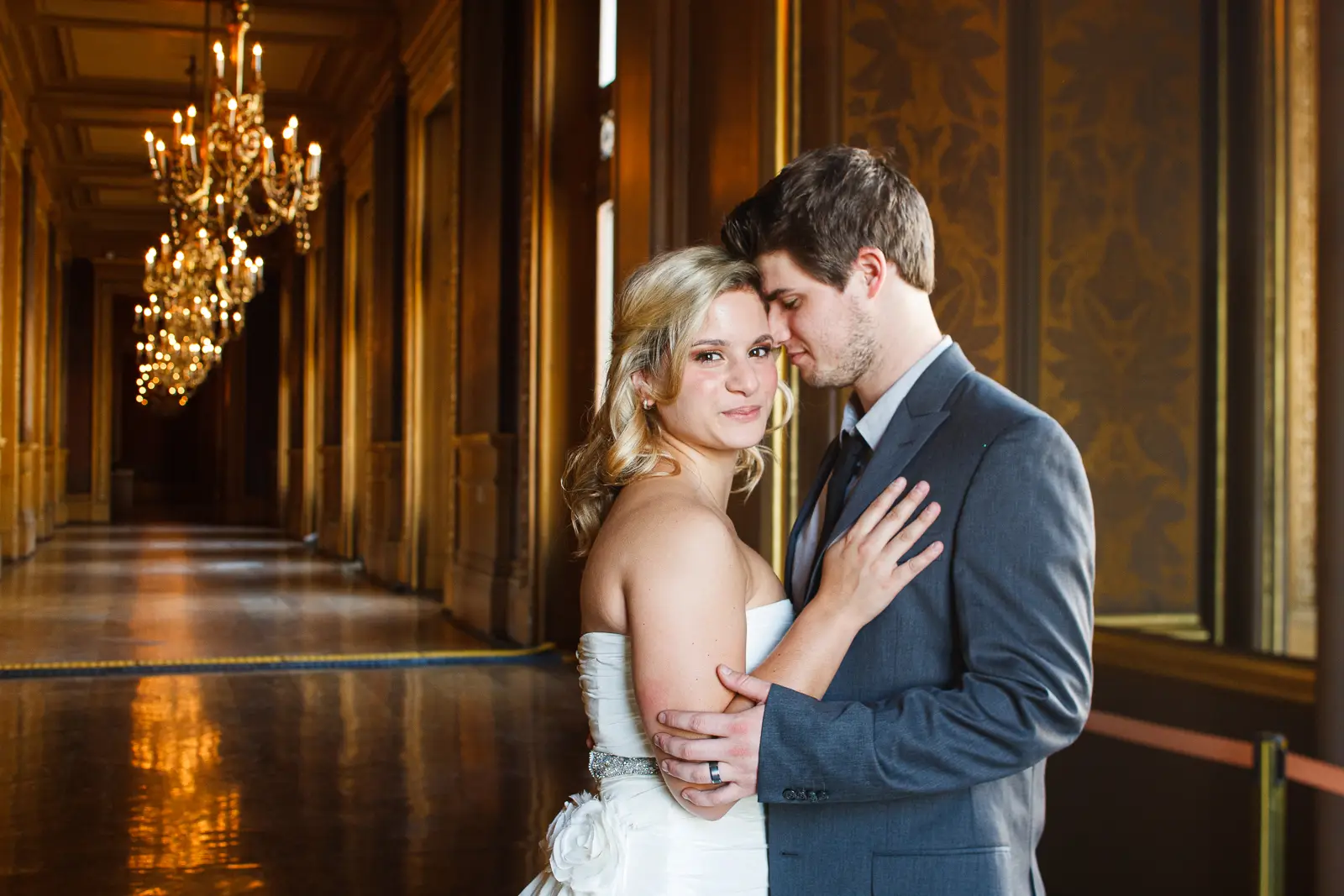
That changes how I compose. In a wide frame I will often place the couple quite small so the architecture can breathe around them. In a closer portrait I simplify the background and let one staircase, doorway or line of light do the work. Moving between those two kinds of photographs gives the final gallery rhythm. You see where the couple is, then you come close enough to see how they feel.
I also look for photographs where the architecture helps create a natural action. A staircase gives a reason to walk. A balcony gives the couple somewhere to pause and look at each other. A long corridor creates movement. Those small actions are more useful than inventing complicated poses because they keep the photographs connected to the place.
A public monument needs a different approach from a private venue..
The Opera is not a private studio. Even with permission, there may be visitors moving through the building, staff working nearby and areas that are temporarily busier than others. That is why I prefer to work with a clear visual plan rather than arriving with a long list of specific poses that have to happen in a specific order.
If the grand staircase is busy, we can start with tighter portraits or use a landing where the background is cleaner. If a particular view opens up for thirty seconds, we can use it immediately. The session works better when the photographer can read the room and change direction without making the couple feel that something has gone wrong.
This is also one reason I do not recommend trying to change outfits repeatedly inside a short interior booking. Every interruption costs more than the minutes it takes to change. You lose momentum, you may lose a clean space that had just become available, and it becomes harder to keep the couple relaxed. A strong first look, photographed properly, usually gives more value than several rushed looks.
Direction should solve a photographic problem, not turn the session into a performance..
Some direction is useful at Palais Garnier because the architecture is very precise. I may move a couple a few steps to line them up with the staircase, ask one person to turn toward the window, or wait until a dress falls in the right way. Those decisions are about composition and light.
Once the frame is working, I want the couple to stop thinking about the pose. Walking slowly, talking, adjusting a jacket, turning back toward each other or simply standing quietly for a moment usually produces more convincing photographs than a long sequence of fixed instructions. Tabitha and Nathan's live story is a good example because the formal setting is balanced by laughter, dancing and the small moments between the larger portraits.
The strongest galleries normally contain both. You need the photograph where the whole Opera staircase is visible and everything is carefully placed. You also need the closer image where the location almost disappears and the photograph is simply about the couple. One gives the story its scale; the other gives it intimacy.
How to build the rest of the day
Let the Opera be the anchor, then simplify everything around it..
Once the Palais Garnier time is confirmed, I would plan the rest of the session around it rather than treating the Opera as one stop among many. The interior is already visually rich, so the next part of the day should be simpler and easier to move through.
For example, an Opera session followed by the Louvre gives you a strong change from warm, decorative interiors to stone, glass and open space. Pont Alexandre III changes the scale again with the river, sky and distant city. The Tuileries can be even softer, especially if the couple wants walking photographs and something less formal after the Opera.
What I would avoid is a route that tries to include the Opera, Louvre, Eiffel Tower, Montmartre and several cafés in the same short session. Paris looks compact on a map but traffic, walking, parking and outfit changes can turn that plan into a series of transfers. The photographs usually become better when the route contains fewer locations and more actual shooting time.
If a couple wants both the Opera and several landmarks, a longer session or a separate second day is the cleaner solution. That gives each location a reason to be there instead of reducing everything to a quick stop.
Palais Garnier is strongest when you genuinely want formality and architecture..
I would recommend the Opera to couples who are drawn to elegant interiors, fashion, old Paris architecture and a more editorial visual language. It works particularly well when the clothes are an important part of the shoot and when the couple wants photographs that feel different from the familiar Eiffel Tower viewpoints.
It is probably not the best first choice for a couple who wants an entirely relaxed street session, café photographs and lots of spontaneous walking through neighbourhoods. Those photographs can still be made later, but Palais Garnier itself has a certain level of formality. Working with that character rather than fighting it is what makes the location worthwhile.
The useful question is not whether the Opera is one of the most impressive places in Paris. It clearly is. The question is whether that atmosphere belongs in your own gallery. If the answer is yes, it can become the visual centre of the whole pre-wedding session.
What couples usually need to know before planning it..
Yes. Photography access should be arranged in advance. Availability and rules can change, so the Opera booking should be confirmed before the rest of the Paris route is built around it.
Earlier sessions are usually the most practical because the building is quieter and the window light is softer. The exact choice depends on access, season and the rest of the route.
Formal clothing suits the scale of the interior particularly well. Flowing gowns, tailored suits and elegant details work naturally with the marble, gold, chandeliers and grand staircases.
Yes. A second outdoor location can give the final gallery more contrast. The Louvre, Pont Alexandre III or the Tuileries can work depending on the timing and the look you want.
Want Palais Garnier to be part of your own Paris session?.
Send me your date, the look you want and whether the Opera would be the main location or one part of a longer Paris shoot. I can help you work out what fits realistically around the access time and the rest of the city.